Researchers discover world’s ‘northernmost’ island


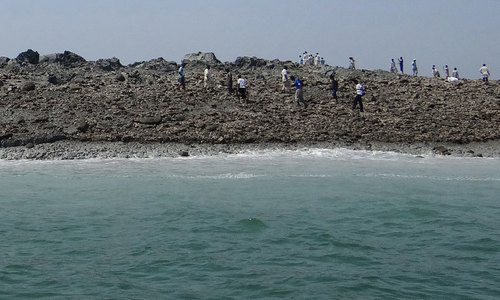
COPENHAGEN: Scientists have discovered what is believed to be the world’s northernmost landmass — a yet-to-be-named island north of Greenland that could soon be swallowed up by seawaters.
Researchers came upon the landmass on an expedition in July, and initially thought they had reached Oodaaq, up until now the northernmost island on the planet.
“We were informed that there had been an error on my GPS which had led us to believe that we were standing on Oodaaq Island,” said the head of the mission, Morten Rasch from Copenhagen University’s department of geosciences and natural resource management.
“In reality, we had discovered a new island further north, a discovery that just slightly expands the kingdom” of Denmark, he added.
Scientist says it’s only 30 to 60 metres above sea level and could be a ‘short-lived islet’
Oodaaq is some 700 kilometres south of the North Pole, while the new island is 780 metres north of Oodaaq.
Copenhagen University said in a statement late on Friday the “yet-to-be-named island is... the northernmost point of Greenland and one of the most northerly points of land on Earth”.
But it is only 30 to 60 metres above sea level, and Rasch said it could be a “short-lived islet”.
“No one knows how long it will remain. In principle, it could disappear as soon as a powerful new storm hits.”
The autonomous Danish territory of Greenland has grabbed headlines in recent years, most notably in 2019 when former US president Donald Trump said he wanted to buy the Arctic territory.
The proposal, described as “absurd” by the Danish government, caused a diplomatic kerfuffle, but also signalled renewed American interest in the region.
It has also been hard hit by climate change as warmer temperatures have melted its glaciers, causing alarming sea level rise.
Published in Dawn, August 29th, 2021