In a first, Thailand to mix Sinovac, AstraZeneca vaccine doses


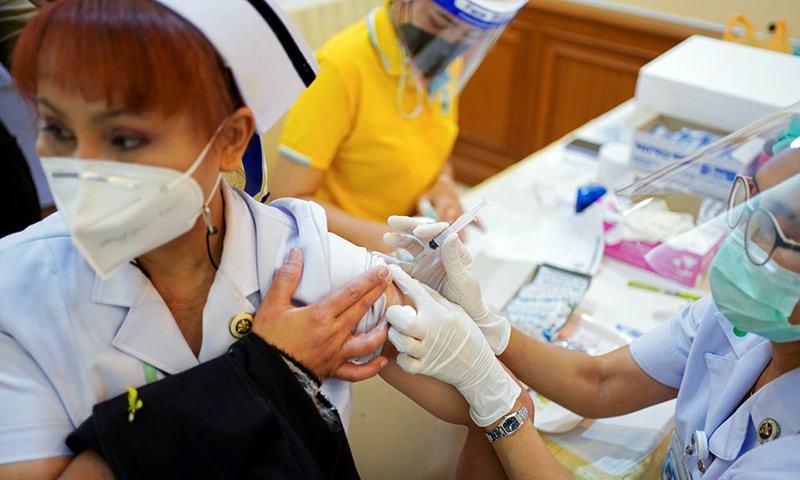
Thailand will use AstraZeneca Plc's Covid-19 vaccine as a second dose for those who received Sinovac's shot as their first dose in a bid to increase protection, it said on Monday.
The move is the first publicly announced mix-and-match of a Chinese vaccine and a Western-developed shot, as a new preliminary Thai study raised doubts about the longer-term protection of the two-dose course Sinovac vaccine.
“This is to improve protection against the Delta variant and build a high level of immunity against the disease,” Health Minister Anutin Charnvirakul told reporters, adding that the second dose of AstraZeneca would come three or four weeks after the first Sinovac shot.
There have been no studies specifically on mixing Sinovac and AstraZeneca released, but a growing number of countries are looking at mix-and-match of different vaccines or giving a third booster dose amid concerns new and more contagious variants may escape approved vaccines.
The announcement came a day after Thailand's health ministry said 618 medical workers out of 677,348 personnel who received two doses of the Sinovac vaccine became infected from April to July. One nurse died.
Neighbouring Indonesia has also reported breakthrough infections among medical and frontline workers who are fully inoculated with the Sinovac vaccine.
Thailand now plans to give booster shots of imported mRNA vaccine to its frontline workers — who were given imported Sinovac before the locally manufactured AstraZeneca vaccine was available in June. Indonesia is considering similar boosters.
On Monday, a preliminary Thai study of 700 medical workers indicated that Sinovac's protection rate as measured by antibody level ranged between 60 per cent and 70pc for the first 60 days after the second dose, but the rate steadily went down over time and appeared to halve every 40 days.
“From our research, if our medical staff received two doses of Sinovac [...] they should definitely get a third booster shot,” Sira Nanthapisal, a researcher at Thammasat University's Faculty of Medicine, told Reuters. The researchers have yet to release their full study data.
“They can do that either between AstraZeneca or Pfizer when it arrives, and we will continue to monitor their antibodies,” Sira said.
An AstraZeneca representative declined to comment on Thailand's decision, saying only that vaccination policy is a matter for each country to decide.
Sinovac did not respond to requests for comment on Monday.
Last month, Sinovac spokesman Liu Peicheng told Reuters preliminary results from blood samples of the vaccinated showed a three-fold reduction in neutralising effect against the Delta variant and suggested a third Sinovac shot could elicit more durable antibody reaction.
Thailand on Monday implemented its toughest coronavirus restrictions in more than a year in Bangkok and surrounding provinces, amid a fast-rising wave of the highly transmissible Alpha and Delta variants, with cases rising to nearly 10,000 per day and record deaths.
The measures, initially for two weeks, include widespread suspensions by airlines and bus firms, a curfew, mall closures and a five-person limit on gatherings.
The vast majority among the total 345,027 cases and 2,791 fatalities have been since April after nearly a year of largely controlling the virus, but there has been a slow start to its mass vaccination rollout that only began last month.