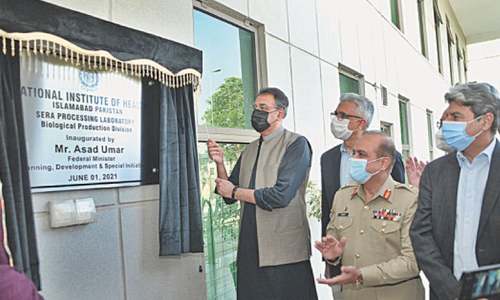
THE news on the vaccine front in the country is adding to a cautious optimism that the worst of the third wave is over, or at least it is headed in that direction. Tuesday saw the inauguration of an antisera processing plant and the launch of 120,000 doses of PakVac produced locally from the Cansino vaccine concentrate under the fill-finish operation, which is the final step in the overall manufacturing process.
Meanwhile, concentrate for another 900,000 doses has been procured for processing.
According to the National Institute of Health, the aim is to produce 3m doses per month as well as the raw material for the vaccine. That would be sufficient for 3m people on a monthly basis to be fully inoculated as it is a single-dose vaccine.
Despite being the fifth largest internal market, Pakistan lags far behind in the biopharmaceutical industry that comprises vaccines and high-cost recombinant biological drugs. It imports all its vaccines, and produces only a few antisera such as for rabies and snake venom, based on simple technology that has been around for decades. No modern vaccines or any other biological products are produced from scratch in this country.
Read: All you need to know about Covid vaccines in Pakistan
Until a few years ago, the measles vaccine was being processed here under the fill-finish function. The same facilities at the National Institute of Health have been revived for processing PakVac from the Cansino concentrate. The fill-finish step is a critical one that requires quality assurance and proper cold chain management for which CanSinoBio experts from China are lending their technological assistance.
The Covid-19 pandemic has led to a shifting of priorities in the health sector: one of them is the importance of funding vaccine research. International organisations, such as the WHO, and Gavi the vaccine alliance are also promoting the idea of helping countries operationalise their existing unutilised capacity to produce vaccines. Similarly, there is now a global will to assist with technology facilitation and transfer that can enable developing countries to produce their own vaccines and recombinant biological drugs. Pakistan must seize the moment to make up for lost time. The government should open up the biopharmaceutical sector to public-private partnership, or even to the private sector independently, to develop the latest mRNA class of vaccines. It can incentivise such ventures by offering tax holidays, facilitating the import of machinery, etc. A window of opportunity is beckoning Pakistan, and the country must not squander it.
Published in Dawn, June 3rd, 2021