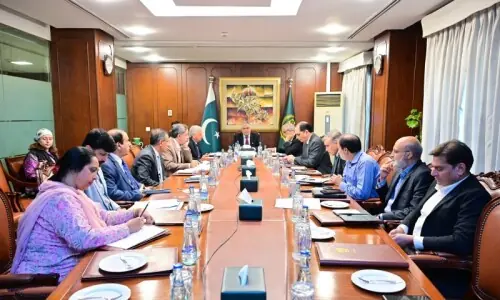
LAHORE: Any policy or planning to improve the power sector in Pakistan can be effective only if the decisions related to them are made in an open, transparent, participatory, and inclusive manner. Exprets said this at a virtual press conference on Friday. They say the policy and planning decisions/targets can be realistic, well-informed, and set in the right direction only if they are based on a bottom-up approach, involving broad-based consultations with all stakeholders, most importantly the communities/end-consumers, and catering to their specific needs and stakes.
Discussing the Integrated Generation Capacity Enhancement Plan-2047 (IGCEP-2047), experts said the National Transmission and Dispatch Company (NTDC) has not taken into consideration the needs and requirements of all stakeholders, especially the local communities who are the most likely to be affected by the planned power projects. The IGCEP-2047 points out shortcomings in the data input requirements and planning procedures laid out in the grid code and also indicates the non-transparent nature of these planning decisions.
Muhammad Ali Shah from Pakistan Fisherfolk Forum, Zain Moulvi, legal and policy analyst at Alternative Law Collective, and Haneea Isaad from Rural Development Policy Institute said the IGCEP-2047 - a long-term plan for enhancing electricity generation capacity based on forecasts of growing power demand till 2047 - and Competitive Trading Bilateral Contract Market - a plan to set off operations of the wholesale competitive electricity market in April 2022 - are characterized by their opaque, arbitrary and exclusionary nature. They said they found these plans least sensitive to the concerns of communities/end-consumers and are too ambitious in forecasting electricity demand. The plans are riddled with flawed economic reasoning, and recklessness in prioritizing the share of dirty fossil fuels, particularly coal, based power in the national energy mix.
They said the decision to hold the press conference was taken in the backdrop of the policy and planning measures, which the government of Pakistan was taking to address the financial, economic, and climate change-related challenges afflicting the power sector in the country.
“Numerous inaccuracies and misappropriations have been reported in the IGCEP-2047 document circulated amongst the public last year. Owing to the reservations voiced by a variety of public and private stakeholders, Nepra directed the NTDC to revise the document and share it by the end of last year. However, there has been no sign of an updated document so far,” said Shah on the occasion. “It seems that the revised version of the IGCEP-2047 will come out this year instead. However no move has been made by the NTDC to consult the public over it,” he added.
Zain Moulvi said renewable energy options, which are far cheaper, seem to have been ignored in favor of fossil fuels without taking into account the cost of environmental externalities or the huge water requirement of these power plants. “The World Bank’s report on Variable Renewable Energy uses the same system constraints and software and proposes an entirely opposite generation mix, where added coal doesn’t even come into play until 2033,” he maintained.
Haneea Isaad discussed rising share of coal and the corresponding decline in renewables envisioned in the IGCEP-2047 is evidence of a systemic issue. “NTDC and NEPRA simply do not have a mechanism for streamlining plans in accordance with national policies and long-term goals of sustainable development. In particular, the IGCEP-2047 violates the Alternative Renewable Energy policy of 2019 which is an integral part of the broader National Electricity Plan as per section 13A (2) of the Nepra Act,” she explained.
Published in Dawn, April 24th, 2021