ISLAMABAD: After consecutive increases for many months, the electricity rates for consumers of 10 distribution companies (Discos) of Wapda are set to go down by over 61 paisas per unit under monthly fuel cost adjustments for March.
The National Electric Power Regulatory Authority (Nepra) will take up for public hearing on April 28 the tariff petition seeking reduction in consumer tariff for Discos on account of fuel cost adjustment of electricity consumed in March. The lower fuel cost, on approval by the regulator, would be adjusted in consumer bills in the upcoming billing month of May.
The Central Power Purchasing Agency (CPPA) on behalf of Discos has demanded a reduction of 61 paisas per unit to pass on the benefit of better energy mix with consumers. Officials said that for a long time power companies have themselves been requesting a reduction in rate.
They said the fuel costbased tariff reduction was due last year but the government had kept the prices unchanged for almost three quarters and were set against higher fuel costs in subsequent months.
The lower electricity rates, on approval by the regulator, would not benefit consumers using less than 300 units and agriculture consumers on the premise that they enjoyed subsidised rates. This would also not be applicable to K-Electric consumers.
The CPPA said it had charged consumers a reference fuel tariff of Rs6.23 per unit in March while the actual fuel cost turned out to be Rs5.61 per unit and hence 61 paisas per unit should be adjusted in consumers’ bills for next month.
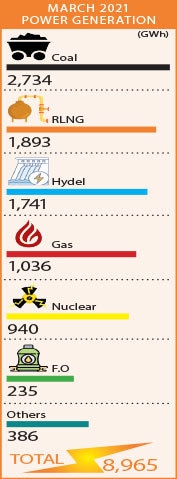
Total energy generation from all sources in March was recorded at 8,965 Gwh at a total cost of Rs49.7 billion at an average rate of Rs5.55 per unit. Of this, about 8,614 Gwh were delivered to the Discos at Rs48.37bn, at an average rate of Rs5.61 per unit.
The data showed that hydropower generation contributed 19.4 per cent of overall energy mix compared to 28pc in February and 13pc in January.
As a result, the share of coal generation increased slightly to 30.5pc in March against 26pc in February and about 32pc in January.
On the other hand, the generation from furnace oilbased plants stood at 2.62pc against just 1pc in February and 12pc a month earlier. There was absolutely no power intake from power plants based on high speed diesel.
The share of RLNG-based power generation to national grid increased to 21pc in March compared to 17.5pc in February and 11.3pc in January. The generation from local gas stood at 11.52pc against 12.45pc in February.
On the other hand, the share of nuclear power remained generally unchanged at 10.49pc. The share of wind power and baggase stood at 1.89pc and 1pc respectively.
There was no fuel cost on hydroelectricity while coal-based fuel cost stood at Rs7.25 per unit in March. Nuclear energy fuel cost stood at slightly over Rs1.03 per unit while power produced from local gas stood at Rs7.65 per unit. The cost of RLNG-based plants was worked out at Rs9 per unit.
The electricity imported from Iran had a cost of Rs9.4 per unit and its total share in power supply was just 0.43pc. The most expensive generation came at Rs11.9 per unit from furnace oilbased plants.
Under the tariff mechanism, changes in fuel cost are passed on to consumers only on monthly basis through automatic mechanism while quarterly tariff adujustments on account of variation in power purchase price, capacity charges, variable operation and maintenance costs, use of system charges and including impact of transmission and distribution losses are built in the base tariff by the federal government.
Published in Dawn, April 22nd, 2021