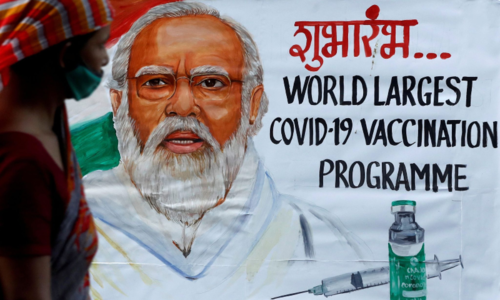
India's health workers balk at taking homegrown Covid-19 vaccine


India is struggling to convince its health and frontline workers to take a homegrown Covid-19 vaccine controversially approved without late-stage efficacy data, government data showed on Thursday, days ahead of a wider rollout.
The country has the world’s second-highest number of Covid-19 infections after the United States, with cases recently surging as mask wearing declined and states eased social distancing measures. A lack of confidence in a homegrown vaccine could prevent India from meeting its target of vaccinating 300 million of its 1.35 billion people by August.
India has vaccinated more than 10.5m health and frontline workers since beginning its immunisation campaign on January 16.
But only 1.2m, or about 11 per cent, of them have taken Covaxin, the locally-developed vaccine from Bharat Biotech, while the remaining 9.4m have used the vaccine licensed from AstraZeneca, according to the government’s Co-Win online platform used to track the vaccination drive.
India’s federal government has so far ordered 10m doses of Covaxin and 21m doses of the Oxford University/AstraZeneca shot. The government says it has received at least 5.5m Covaxin doses.
“It’s all because of the initial discussion about how [Covaxin] was only an experimental vaccine, how it had not completed the Phase III trial,” said Dr Subhash Salunkhe, who advises the Maharashtra state government on vaccine strategy.
“These things created doubts in the minds of people, resulting in lesser acceptance. The availability is not a concern at this juncture.”
However, India’s Health Secretary Rajesh Bhushan on Tuesday attributed the lower uptake of Covaxin to Bharat Biotech’s limited production capacity compared to that of the Serum Institute of India, the world’s biggest vaccine producer, which is making the AstraZeneca shot for low and medium-income countries.
“We have found that in proportion to the quantity of vaccine available with us, [Covaxin's] offtake is fairly satisfactory,” told a news conference.
His ministry did not respond to a request seeking comment on the latest figures showing that only about 12pc of the ordered doses had been administered.
Earlier this month, Chhattisgarh, an opposition-ruled state of 32m people, told the federal government it would not use Covaxin until its efficacy could be proven in an ongoing late-stage trial. Epidemiologist and public health experts have also criticised the Covaxin approval as rushed.
Bharat Biotech has said efficacy data from the trial on nearly 26,000 volunteers will be out soon. The company, along with India’s drug regulator, says the vaccine is safe and effective based on early and intermediate studies.
Bharat Biotech did not immediately comment on the lower uptake of its vaccine.
Cases rising
The government is trying to expedite vaccinations as cases have surged, especially in Maharashtra in the west and the southern state of Kerala, possibly as they have reopened suburban trains and schools.
Mask-wearing and social distancing have also largely vanished, with big events like international cricket matches being played in front of tens of thousands of spectators hardly following any Covid-19 rules.
India reported 16,738 new coronavirus infections in the past 24 hours, the highest daily jump in a month, health ministry data showed on Thursday, raising the total to 11.05m.
More than half of the new cases were in Maharashtra, India’s richest state and home to its financial capital Mumbai, which reported a record high of 8,807 cases on Wednesday.
Deaths across the country rose by 138, also the highest in a month, taking the total to 156,705.