47
47

THE PTI government has finally mustered up sufficient political prudence to extend an olive branch to the opposition in an attempt to build a better working relationship in parliament. But many say it is a case of too little, too late.
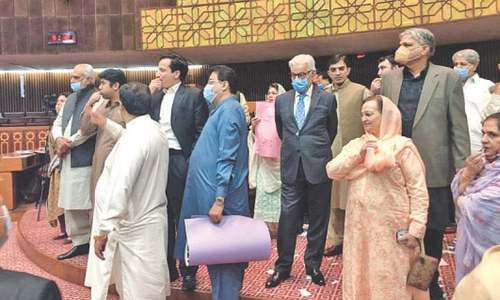
According to a report in this newspaper, a three-member delegation from the treasury benches visited the parliamentary chamber of the Leader of the Opposition Shehbaz Sharif and asked for the opposition’s help in running the business of parliament more smoothly. The delegation, which included Defence Minister Pervez Khattak, Parliamentary Affairs Minister Ali Muhammad Khan and Chief Whip Amir Dogar, argued that the two sides should collaborate to bring down the temperature in the House and work together on people-friendly legislation.
The opposition, however, reminded them that it is the government that has been calling the opposition thieves, dacoits and traitors. The opposition members said the government was only reaching out because the opposition was taking them to task on the Broadsheet scandal.
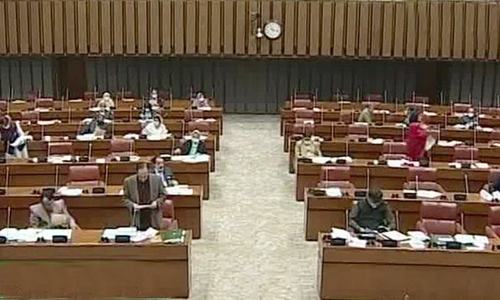
It is no secret that ever since the PTI came to power, parliament has been reduced to a wrestling ring where shouting matches have taken the place of serious legislative work. The government shares the bulk of the blame for this sorry state of affairs. Prime Minister Imran Khan, who had once promised that he would hold a question hour regularly in parliament, has now almost totally absented himself from the proceedings. The treasury benches too have made it their priority to bring their street politics into parliament. As a result, legislative work has almost ground to a halt and parliament’s role as the centre point of a democratic system has diminished considerably. Perhaps the government did not realise that making parliament dysfunctional to browbeat the opposition would ultimately have an adverse impact on its own performance.
More than halfway through their term, the treasury benches are now recognising that they have the most to lose if they have little to show for their legislative performance. However it may be a bit too much to expect that the opposition would suddenly turn the other cheek while it is being constantly hounded. The price of confrontational politics is a steep one, as the government may be belatedly realising.
It is though never too late. The government should go the extra mile to improve the environment in the House and establish a basic minimum working relationship with the opposition. A good first step would be for the government to get off its high horse and engage the opposition in some meaningful dialogue that goes beyond optics. Two issues demand urgent attention: electoral reforms and amendments to the NAB ordinance. If the government can bring itself to stop targeting and heaping scorn on the opposition, perhaps some steady progress can be made on the floor of the House.
Published in Dawn, January 24th, 2021