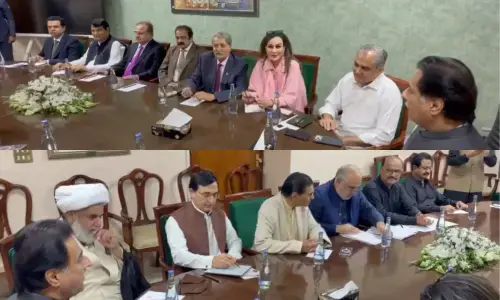
KARACHI: Participants in the fourth senate meeting of Jinnah Sindh Medical University (JSMU) raised concerns about the status of the university’s faculty as the federal government has started the process to take over three major tertiary care hospitals of the city, which currently serve as teaching hospitals for over 7,000 JSMU students.
It may be recalled that recently the Ministry of National Health Services, Regulations and Coordination has released a notification under which four health facilities — Jinnah Postgraduate Medical Centre (JPMC), National Institute of Cardiovascular Diseases (NICVD), National Institute of Child Health (NICH) and Lahore’s Sheikh Zayed Postgraduate Medical Institute (SZPMI) — have been added to the Schedule of Federal Medical Teaching Institutes Ordinance, 2020.
Speaking at the senate meeting, JSMU Vice Chancellor Prof Tariq Rafi expressed concern as to what would happen to the status of the university’s faculty against the backdrop of the federal government’s steps to take over these institutions.
Health Minister Dr Azra Fazal Pechuho said the provincial government was cognizant of the problem and trying to sort it out.
The minister, also the pro-chancellor of the university, spoke about the concerns the provincial government had about the Pakistan Medical Commission Act 2020 and said the law was being studied thoroughly so that the Sindh Medical and Dental Council (SMDC) would fulfil the gaps in the federal legislation.
“The provincial council will be established in consultation with all stakeholders and cover a lot of other areas, for instance, affiliation of universities and medical colleges, their recognition and curriculum, as was being done earlier by Pakistan Medical and Dental Council,” she said, while addressing the meeting.
The provincial government couldn’t bypass the federal legislation under which medical tests had been taken but it can establish an authority (SMDC) to simplify procedures, she added.
Earlier, Prof Rafi presented an overview of the past two years of the university’s performance and said the university had taken steps to attract qualified human resources and offering increments and paid leave to contract employees.
He also informed the meeting that the university was generating 60 per cent of its budget from its own resources as the government grant was reducing steadily.
Later, he presented the university budget of Rs1.9 billion with a Rs490m deficit. “This would be overcome with austerity measures and the government’s grant,” he said.
Published in Dawn, January 13th, 2021