WILL the peace process between Afghanistan’s warring parties be put at risk by the Pentagon’s recent announcement that more US troops will be withdrawn ahead of schedule? Not really. Factors other than troop levels are more significant for the future of peace talks. In any case, troop levels have progressively been going down since the Doha agreement of February between the US and the Taliban. The drawdown of another 2,000 troops, planned by mid-January, will likely have limited impact on the situation especially as the US will still retain air power and maintain a CT capability.
Also, several thousand Nato-led international forces are present to train, advise and assist Afghan forces and aim to leave when ‘conditions allow’. Above all, international leverage will now shift from military to economic means — the military option being all but exhausted.
Nevertheless, the key to Afghanistan’s future is whether the intra-Afghan dialogue can make enough progress towards a settlement, including a ceasefire, before all international forces leave Afghanistan and global interest wanes. The intra-Afghan process that began in September as a consequence of the Doha accord faces imposing challenges. Delays in its initiation were due to wrangles between Kabul and the Taliban over prisoner exchanges. Once these disagreements were resolved the dialogue got underway in Qatar. Talks are now reported to be nearing agreement over procedures and terms of reference (TORs) for negotiations. This will open the way to talks on substantive issues including a ceasefire. The US Secretary of State Mike Pompeo’s visit to Doha and meeting with the Taliban’s chief negotiator Mullah Abdul Ghani Baradar was aimed at accelerating the peace talks following the Pentagon announcement.
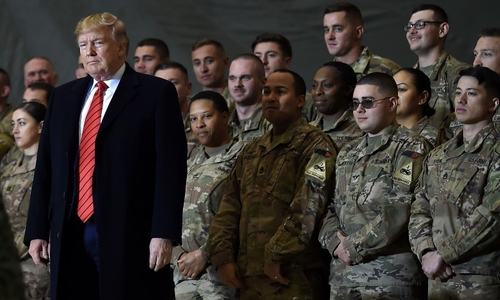
Not everyone agrees that a speedier pullout of troops will have marginal effect. After 2,000 are pulled out in January — under the Doha accord this was to happen in May 2021 — about 2,500 American troops will be left in Afghanistan. Some media reports indicate how several US allies have been “rattled” by this decision, which obviously seeks to make good President Donald Trump’s pledge to bring American soldiers home before he leaves office. The chairman of Afghanistan’s High Council for National Reconciliation, Abdullah Abdullah, said while he respected this decision “it has come too soon”. Nato Secretary-General Jens Stoltenberg cautioned that the “price for leaving too soon or in an uncoordinated way could be very high”.
It is up to the Afghan parties to make the tough compromises needed to secure a settlement.
Some Congressional Republicans and American analysts fear that this accelerated exit would toughen the Taliban’s negotiating position. For their part, the Taliban have welcomed the US announcement as a “good step” that would help bring an end to the war.
While Pakistan has repeatedly called for a “responsible US troop pullout”, officials were neither surprised nor worried about the latest development and believe this might even encourage Washington to step up and impart more urgency to diplomatic efforts to goad the Afghan parties into accelerating progress in substantive negotiations.
The incoming administration of Joe Biden is not likely to change course on the military drawdown especially as this has now gone so far ahead. Moreover, the president-elect has in the past not favoured continued military engagement in Afghanistan and instead urged an end to “forever wars”. There is speculation that his administration might slow down the pullout of remaining US forces in deference to the view of many defence officials and Nato allies. This too is unlikely to make an appreciable difference to the on-ground situation in Afghanistan. A key question is how early and substantively the Biden administration focuses on the Afghan issue given its heavy domestic agenda and other more pressing foreign policy priorities.
The current uptick in violence in Afghanistan is worrisome for all stakeholders including the country’s neighbours. This figured prominently in talks between Pakistan and Afghanistan when Prime Minister Imran Khan recently visited Kabul. Some intensification of violence was expected as the Afghan parties seek to expand areas under their control to strengthen their negotiating hand. But this does not explain the pattern of increased violence. There is a puzzling aspect to some of the urban violence and terrorist attacks which raises the question of whether this is being orchestrated by internal and external spoilers who are loath to see the talks make headway. True or not, the spike in violence is creating an extremely fraught environment and adding to the uncertainty that clouds the peace talks. However, once TORs are formally agreed the next phase of talks is expected to focus on the reduction of violence — crucial to create an atmosphere of trust and calm for the arduous negotiations that lie ahead.
Meanwhile, a pledging conference for Afghanistan that took place recently in Geneva, co-hosted by the UN and Finland, and attended mostly virtually by 100 countries and international organisations, saw the US, EU and other donors commit around $3 billion for Afghanistan next year and $12bn over the next four years. What was significant was that pledges were conditioned on tangible progress in peace talks and a ceasefire although the EU also made assistance contingent on the ‘preservation of human rights gains’. A top US official announced that while it was pledging $600 million for 2021, only half would come now “with the remaining available as progress in the peace process is reviewed”. Pompeo was more direct:“The choices made in peace negotiations will affect the size and scope of future international support and assistance.”
This underlines that the international community’s economic leverage will be more important in the months ahead than other means to influence the negotiating parties into making progress. Both Kabul and the Taliban see continuance of international assistance as necessary as they know that without funds state collapse is threatened. Even though international influence will diminish over time economic incentives rather than coercive pressure will be the likely vehicle to influence the peace process.
Pakistan, Afghanistan’s other neighbours and the international community have obvious if varying stakes in the country’s peaceful future and will try to assist in whatever way they can. But it is up to the Afghan parties to make the difficult compromises needed to secure a peace settlement. Afghanistan’s destiny can only be determined by Afghans themselves.
The writer is a former ambassador to the US, UK and UN.
Published in Dawn, November 30th, 2020