KARACHI: The Area Study Centre for Europe (ASCE), University of Karachi, organised a symposium on ‘Economic Migration — A Comparative Study, Its Implications and Challenges’ at a local club on Wednesday.
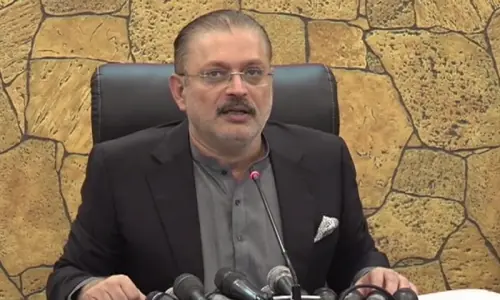
Speaking on the occasion, the Consul General of Germany in Karachi, Holger Ziegeler, said migration was an international challenge. It is caused by conflicts in the world, by wars, by the need to leave home to go somewhere else. About 70 million refugees exist worldwide. Pakistan is one of those countries which suffered from this as it has about two-and-a-half-million refugees from Afghanistan.
Symposium discusses migration in the global perspective
He said the European Union (EU) has a larger role for refugees and migrants worldwide. The reasons are mingled. [On the one hand] there’s a refugee situation. But many people join the stream not because they are in danger but because they think they want to build a better future. Both reasons are legitimate.
“We [in EU] think it’s necessary to help those people who leave their home because it’s burning. We also think if someone leaves the house because it’s falling down and they don’t have the means to repair, so let’s house them [give them shelter] in the beginning and see how they can build their house again,” he added.
Mr Ziegeler also highlighted the European approach to migration over the years.
‘Europe population is declining’
He said five years ago, it seemed everybody came to Europe from different conflict zones. The first challenge was to cope with the situation and then “how can we handle these numbers”. Now about two-thirds of refugees in the EU have been received by four countries — Germany, Italy, Austria and Sweden.
“However, after some policy regulation we have entered a stage of trying to shape migration. Streams have come down; now it’s the question how to generate streams that you want and those you don’t want. The population in Europe in general is declining,” the envoy said
He added that the region did not have many skilled workers. On the other side, there were migrant groups who will have no chance [because of lack of skill] and would have a hard time. “So the governments are trying to handle that as well.”
Karachi University acting Vice Chancellor Khalid Iraqi in his speech hoped that the six young recipients of the project would be able to find the root cause of the urban-rural migration process and through their effort suggest how to manage such an issue.
“If we don’t have an urban strategy then it can cause issues of infrastructure and have socio-political consequences,” he said, adding that low profitability in agriculture enterprise resulted in urban migration, pointing out Pakistan claimed to be an agrarian economy therefore the government should protect the agriculture sector.
Economic migration to Karachi
Earlier, Dr Steffen Kudella, resident representative of the Hanns Seidel Foundation Pakistan which collaborated with the ASCE to hold the symposium, said Karachi might be the very best example of economic migration.
He said 90 per cent of all migrants in the world were economic migrants. When the British arrived in Karachi it was a small town of 40,000 people, and its economy was based on fishery. In 1947 the population of the city was around 350,000 — at the time it was the largest city of the country.
With the arrival of hundreds of thousands of Muslim migrants from India the population increased rapidly. By the census of 1961 Karachi had more than two million inhabitants; by 1981 five million; by 1989 eight million; and today the city has more than 16m people. It is one of the world’s fastest growing cities and the country’s economic centre.
“Today we’re going to discuss the challenges and implications of economic migration with six young students. The symposium is based on a six-month-long academic research project,” he said.
Prof Dr Uzma Shujaat, the research grant focal person, in her welcome address, said the [students’] research covered a wide range of topics. She added no systematic compilation of the urban-rural migration was available. The aforementioned project was an attempt to expand the academic debate on the subject.
The second session of the symposium had presentations of the six grant holders, talks on applying the academic results on migration to a business model and the way forward on migration.
Published in Dawn, November 26th, 2020