Dollar deposit rules tightening up
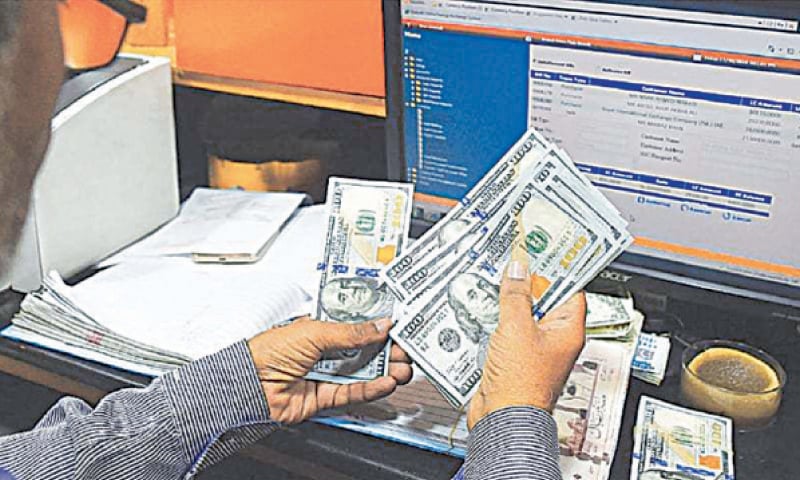

KARACHI: The government has banned individuals from depositing foreign exchange into bank accounts if the forex has been purchased from the open market. It was unclear till the filing of the report, however, whether the new rules issued by the government have significantly changed anything already contained in the State Bank’s Foreign Exchange Manual (FEM).
Chapter 6 of the FEM issued by the State Bank, under which all private foreign currency accounts in the country are opened, lays out the conditions for all FE-25 foreign currency deposits. It states clearly that these accounts, once opened, cannot be fed by borrowed foreign currency, payments for exports or services rendered in or from Pakistan, proceeds of securities issued or sold to non-residents, earnings from overseas operations of Pakistani firms and “any foreign exchange purchased from an authorized dealer in Pakistan for any purpose.”
But on Friday, the government issued a set of new rules through an SRO under the Protection of Economic Reforms Act, 1992 reiterating these rules.
The rules say individual foreign currency accounts will not be credited with remittances received through sources like payment of goods exported from Pakistan; payment of services rendered in or from Pakistan; proceeds of securities issued or sold to non-residents and loans from abroad.
Forex from open market no longer allowed in banks
“A foreign currency account shall not be credited with any foreign exchange purchased from an authorised dealer, exchange company or money changer except as allowed by the State Bank through general or special permission under any law,” said the government’s notification.
However, the rules allow foreign currency brought in from abroad and duly declared at the point of entry into the country with Pakistan Customs to be credited in the account, as well as foreign currency that is being transferred from another bank account.
Currency experts said that with the new steps, the inflow of dollars in banks might be reduced.
“These new rules will stop money laundering particularly in case of export to Afghanistan and Iran as most business with those two countries is not done through banking channels,” said Forex Association of Pakistan President Malik Bostan.
According to him, the new rules make it necessary for anyone depositing dollars into a foreign currency account to first obtain State Bank permission, and the new rules have been formulated specifically with Afghan and Iran trade in view.
“Much of the trade with Afghanistan and Iran is carried out using dollars purchased from the open market to first initiate the transaction” he tells Dawn.
The rules for trading with these countries require the exporter to get advance payment from their customer, which exporters here would usually circumvent by simply buying dollars from the open market, depositing it in their foreign currency account before the transaction has even been initiated. “Its a complex system” he says, “but the new rules basically make it impossible since now these traders will require State Bank permission before depositing those dollars into their accounts.”
However, Tola Associates, tax and corporate advisers identified some problems in the new government rules.
“Restricting such credits will pose severe practical difficulties for individuals who use such foreign currency accounts for the purpose of remittances of education expenses abroad, investment in foreign securities, investment in foreign currency savings accounts, etc.,” said a report by the Tola Associates.
The restriction means such individuals may only feed their foreign currency accounts through other foreign currency accounts (which will also ultimately drain) or through a foreign source.
Moreover, the e-commerce industry in the country is growing at a rapid pace and more and more young professionals are engaged in providing IT and IT-enabled services from Pakistan to foreigners. They receive their payments in foreign exchange through money exchanges etc. due to non-availability of global financial platforms (like PayPal) in the country.
These professionals also have to pay for digital tools in foreign currency which they manage through their foreign currency accounts. “Such restriction will only create hurdles for already struggling e-commerce market in Pakistan despite tremendous global opportunities and demand for country’s freelancers,” said the report.
Ultimately, they will create offshore companies and foreign accounts and will route their funds to these accounts instead of bringing them into the country, it added.
Published in Dawn, October 11th, 2020