Shelling transforms Karabakh capital into ghost town


STEPANAKERT: Best known for its pomegranates, vodka and “jangyl” — a delicious herb bread — the self-proclaimed capital of Nagorno-Karabakh has been turned into a ghost town after days of shelling.
Normally a bustling little city known for its fresh air high in the Caucusus mountains, Stepanakert is now disfigured and most of its 55,000 ethnic Armenian inhabitants have fled Azerbaijani attacks.
On Tuesday, after a night and morning without explosions, the few still here, most of them elderly, were cautiously venturing out from their shelters to search for supplies and to assess the damage.
Just three days earlier, life was going on much as normal on the colourful streets as Armenia and Azerbaijan fought mainly 30 kilometres away on the front line.
A charming provincial city, Stepanakert was the pride and joy of the so-called “Artsakh” republic, proclaimed in 1991, even if not internationally recognised.
The city has close links with neighbouring Armenia. Then on Friday, the first rockets and shells fell — a deluge of them.
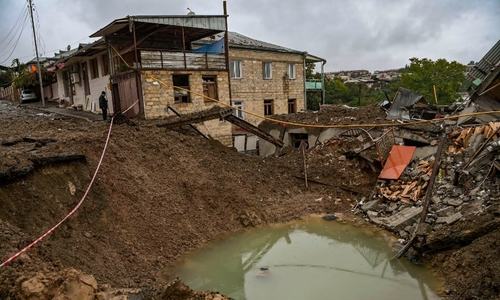
Today, the collapsed buildings, the shops with the windows blown out, the pock-marked facades of buildings all bear witness to that onslaught.
And in at least two spots, what appear to be unexploded munitions have been cordoned off.
In the city’s main avenue, most of the shop windows have been smashed.
What looks like a Soviet-era building, a soulless-looking cubic construction just next to the local defence ministry, has taken the brunt of the shelling, its windows blown out and the vehicles in the car park below destroyed.
On a hill in the Sasuntsi Davit district (named after an Armenian hero), the asphalt road and a multi-storey house have been destroyed, leaving a crater some 10 metres (yards) wide. Fragments of asphalt as big as watermelons are scattered across what is left of the road.
The residents, who by some miracle survived, are Vazguer Badassian and his elderly father.
“We were in the middle of taking tea,” says Badassian, who is in his 50s.
“We barely had time to get down into the cellar.” He does not know what it was exactly that hit them, but reckons it had to have packed “at least 500 kilos” of explosives to have wrought such havoc.
A little further down, it is Artsvaberd, a well-known local furniture shop has been destroyed, perhaps in the same blast. And all the windows in the neighbourhood have been blown out. The broken glass from the windows crunches underfoot, the curtains in the blown-out windows, move in the breeze.
An old man picks his away across the debris, careful to avoid some sharp, steel shrapnel in his path.
“I still cry when I see this devastation,” says 83-year-old Jamal Tadevossian, close to tears. “We’ve known bombings here,” he adds.The residents take advantage of the lull to go three floors up to the family flat and retrieve warm clothes and food from the fridge. Some kind soul has brought down the cage containing two parakeets to the shelter, out of harm’s way.
With some respite that morning from the shelling, a few cars were out, some driven by civilians some by men in military clothing — many of them ignoring the local road signs and travelling at speed.
But by early afternoon, the warning sirens sound again and everyone runs to their shelters.
Published in Dawn, October 7th, 2020