0
0


LAHORE: “When noted rights activist and lawyer Asma Jahangir and Advocate Abid Saqi came out of Sahiwal’s high-security jail after meeting Mehr Abdul Sattar in September 2017, out of curiosity I asked what Sattar said about the ill-treatment he is being meted out. Asma eulogised his bravery, saying there is no leader like him as he did not complain even once about his ill-treatment, but kept talking about the political situation of the country,” recalls Farooq Tariq, a farmer leader.
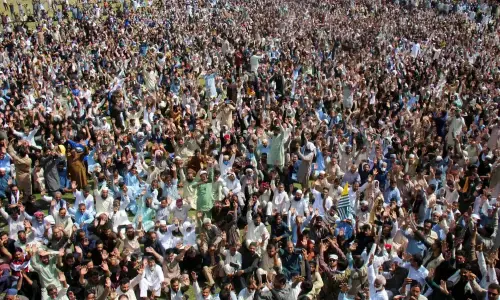
Mehr Abdul Sattar, the general secretary of Anjuman Mazareen Punjab, was accorded a warm welcome when he reached the Okara Military Farms late on Saturday after serving four and a half years in jail.
Hundreds of tenants, both men and women, were there to receive him with open arms.
Sattar had been arrested on April 16, 2016 during a raid on his house at the military farms after he announced holding a big rally at his village, Chak 4/4-L, on the eve of International Farmers’ Day.
A Sahiwal anti-terrorism court had sentenced him to 10 years in jail in 2018.
He was leading a military farms’ peasants movement to win ownership rights since 2001. This was probably the first major mass movement against retired Gen Musharraf as their villages, 19 in all, were besieged by the military farms administration. The women peasants were at the forefront of the movement.
It had erupted when the administration proposed to bring in a contracting system with the peasants and the farmers refused to share their harvest with the administration. The peasants’ leaders, including Mehr Sattar, were booked in dozens of cases that included extortion, treason, terrorism, possessing illegal arms and attacking police.
Senior lawyers like Asma Jahangir, Zahid Bukhari, Azam Nazir Tarar, Abid Saqi, Farooq Ahmad Bajwa and Azar Latif Khan represented Sattar at various stages in cases of murder, attempted murder, extortion, illegal gatherings and others.
His release was strongly demanded by national as well as international human rights organisations. A team of the National Commission for Human Rights, Pakistan’s apex body, had visited Okara after his arrest and in a subsequent report explicitly denied the allegations against him and suggested that all farmer leaders should be released and the dispute between them and the farm administration resolved through dialogue.
In one of the 36 cases registered against Sattar between 2001 and 2016, he was accused of firing at a police constable during a road blockade. The constable had been slightly injured in some encounter. His medical certificate had been found to be presented in several other cases too.
The prosecutor could not satisfy the Lahore High Court when the judge hearing the case remarked that if Sattar fired from a distance of seven feet, the bullet should have pierced through the constable instead of causing a minor injury. The judge then accepted Sattar’s appeal against the sentence.
Published in Dawn, September 14th, 2020