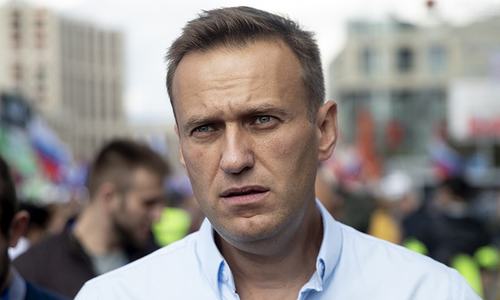
Berlin hospital says Navalny tests ‘indicate poisoning’


BERLIN: The Berlin hospital treating leading Russian opposition figure Alexei Navalny said on Monday that test results indicated he had been poisoned, contradicting the findings of Russian doctors.
The 44-year-old Kremlin critic and anti-corruption campaigner was brought to the German capital on Saturday after falling ill in Siberia last week with what Russian doctors blamed on a metabolic disorder.
“Clinical findings indicate poisoning with a substance from the group of cholinesterase inhibitors,” the renowned Charite hospital in Berlin said on Twitter.
Cholinesterase is an enzyme that is needed for the central nervous system to function properly.
“Alexei Navalny’s prognosis remains unclear; the possibility of long-term effects, particularly those affecting the nervous system, cannot be excluded,” the hospital added.
“Our assertions have now been confirmed by independent laboratory analyses,” Navalny’s spokeswoman Kira Yarmysh said on Twitter.
“Alexei’s poisoning is no longer a hypothesis but a fact.” Chancellor Angela Merkel’s spokesman Steffen Seibert had told reporters earlier it was “fairly likely” Navalny had been poisoned.
Russia’s most prominent opposition figure was rushed into intensive care in Siberia on Thursday after his plane made an emergency landing in the city of Omsk.
His supporters have said they believe he was poisoned by something in his cup of tea at the airport before he took off, pointing the finger of blame at President Vladimir Putin.
The Omsk regional health ministry has said that caffeine and alcohol were found in Navalny’s urine, but “no convulsive or synthetic poisons were detected”.
“The suspicion is... that somebody seriously poisoned Mr Navalny which, unfortunately, there are some examples of in recent Russian history, so the world takes this suspicion very seriously,” Seibert said.
Navalny was flown to Berlin on a medical plane chartered by German NGO Cinema for Peace, an initiative financed by private donations. The transfer came after Merkel extended an offer of treatment in Germany, saying news of Navalny’s condition had “truly upset me”.
The Charite doctors have pledged to carry out an “extensive medical diagnosis”.
Doctors treating him in Omsk initially refused to let Navalny leave but had a change of heart after his family and staff demanded he be allowed to travel to Germany.
Yarmysh claimed Russia’s refusal to evacuate him was a ploy to “play for time” and make it impossible to trace poison.
At a press conference on Monday, doctors in Omsk denied they were pressured by officials while treating Navalny.
“There was no influence on the treatment of the patient a priori and there couldn’t have been any,” said Alexander Murakhovsky, the chief doctor at the Omsk emergency hospital No 1.
Jaka Bizilj, head of Cinema for Peace, told Germany’s Bild newspaper he believed Navalny would survive but “the crucial question is whether he will survive this unscathed and continue to play his role”.
In any case, he would certainly be out of action politically “for at least one or two months”, Bizilj said, meaning he would miss key regional elections next month.
Published in Dawn, August 25th, 2020