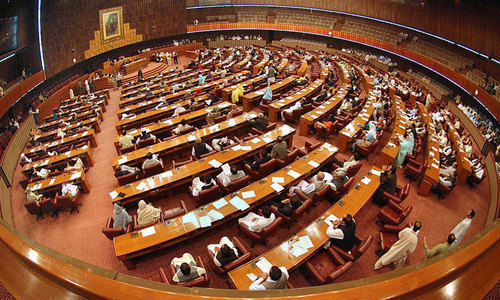
THE second parliamentary year has ended leaving a lot to be desired in terms of the legislature’s performance. A story published yesterday in this paper paints a fairly dismal picture of the work done by the National Assembly and the conduct of its members on the floor of the house.
The data shows the PTI government depended heavily on ordinances for legislation. Of the bills passed, a large number were linked to requirements of the Financial Action Task Force that were supported by the opposition parties after behind-the-scenes consultations. Sessions were often marred by rowdy shouting matches with members even coming to blows on a couple of occasions.
Prime Minister Imran Khan’s scant attendance record also had an adverse impact on the performance of parliament. He only attended nine sittings (less than 10pc) even though one of his main promises during his time as an opposition leader was to attend proceedings regularly if elected prime minister.
Leader of the Opposition Shahbaz Sharif attended merely three sessions during the year mainly on account of his being away in London for a few months and then getting infected with Covid-19.
It is unfortunate that parliament has suffered from a combination of neglect and poor performance. Both ailments are directly connected to the extreme political polarisation on display since the PTI government took power two years ago.
Read: Ordinances outnumber laws passed by National Assembly
This toxic relationship between the treasury and opposition benches has led to a near-absence of any proper working relationship. Parliament has been treated less as a place to engage in healthy debate and enact laws and more as a forum to run down opponents with choice abuse and wild accusations.
The substance of this hallowed institution has been made subservient to the optics generated on the floor of the house. While senior parliamentarians make an effort to inject a semblance of seriousness into legislative business, the sessions often deteriorate to the level of street fights. This may make for good headlines but leads to an abdication of legislative responsibility.
The prime minister shares part of the blame. If he had taken the Assembly more seriously by attending parliamentary proceedings fairly regularly, its functioning could have been much better. This may change after the ruling party gets control of the Senate next year in March. The PTI may then feel more comfortable drawing up a legislative agenda and demanding greater seriousness from its members. At this stage, one can only hope.
Published in Dawn, August 18th, 2020