0
0

KANDAHAR, Sept 18: There’s a buzz at the Zarghona Ana school for girls on the baking edge of Afghanistan’s Registan desert on Sunday. Playful chatter and laughter bounce off the thick, cooling green-and-white walls as dozens of women, most with burqas and veils pulled back comfortably off their face in the absence of men, wait to vote in the first parliamentary ballot in living memory.
From President Hamid Karzai’s mother, Sarajo, to 18-year-old high school students whose mothers had barely been born the last time Afghans chose a parliament, the women in the chaotic southern trading centre of Kandahar, Afghanistan’s second city and birthplace of the Taliban, flocked to have their say.
“I am so happy, so happy,” says Khatereh Mushafiq, 18, her black veil decorated with white flowers pulled back from her beaming face.
“Because, you know, we (women) are also now taking part in the government and in society. People must take part, people must have a say.”
As a handful of blue-uniformed policemen with AK-47s guard each polling station — separate ones for men and for women — Kandaharis queued quietly in the hot sun to cast their vote for the 249-seat Wolesi Jirga, lower house of parliament, and one of 34 provincial councils.
Sixty-eight seats are reserved for women candidates, but the women voters appear to be voting equally for women as for men.
The holdout elements of the Taliban have denounced the election and there was a string of attacks in the southest of the country on Sunday.
All voters were frisked on their way in, seated female election workers sticking their heads under burqas to search and check faces.
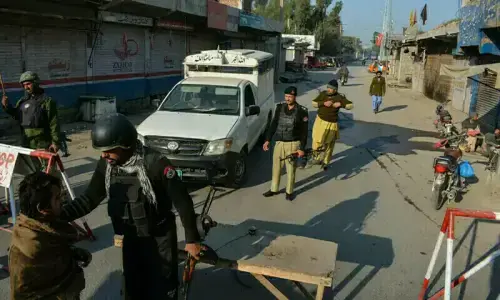
But security was relatively light in Kandahar, one of the major remaining centres of the Taliban insurgency. There were no machine guns at polling stations, no sandbagged bunkers, no armoured cars and few police or troops.
Too few, says election worker Ahmad Salim, 28, at a centre for Kuchi nomads in a half-built building of bricks and mud just outside the city on an eerily quiet Highway 1 to Kabul.—Reuters