Govt plans to restrict use of foreign satellites



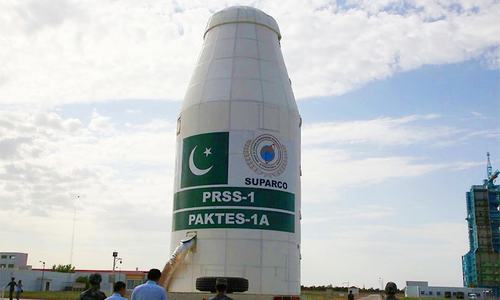
ISLAMABAD: The government plans to restrict use of foreign satellites through introduction of standard operating procedures (SOPs) to ensure maximum capacity utilisation of Pakistani satellites by local users for avoiding foreign exchange flows.
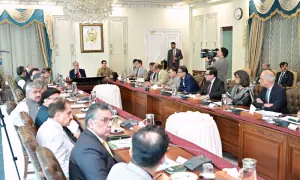
The new policy guidelines and SOPs are on the agenda of the meeting of the Economic Coordination Committee (ECC) of the cabinet scheduled on Wednesday (today).
Informed sources said the summary circulated to the members of the ECC was likely to be withdrawn owing to reservations expressed by some key stakeholders over the SOPs.
To be presided over by Adviser to the Prime Minister on Finance and Revenue Dr Abdul Hafeez Shaikh, the ECC has to take up a nine-point agenda to deliberate on, including supply of natural gas to localities within 5km radius of the gas fields and a series of summaries of the ministry of maritime affairs for various facilities of industrial zones at Port Qasim.
Informed sources said the then prime minister in 2004 had issued directives for maximum utilisation of Pakistani satellite facilities soon after the launch of a satellite at the time. “Paksat Programme-Way Forward” issued at that time by the PM office envisaged parameters and contours for implementation, including administrative, financial and regulatory aspects which needed to be implemented in policy frameworks.
The Strategic Plans Division (SPD) in a summary to the prime minister in March 2019 sought to address voids in regulatory and financial aspects related to sustainability of the National Space Programme, which is an all-encompassing programme envisaging developments in the field of space and having direct linkages with strategic programme.
The ministry of information technology and telecom has reported to the ECC that national space assets’ utilisation could have generated around $544 million (Rs85 billion) since 2004 but still has the potential to generate about $600-700m by 2030 through effective expansion of Paksat Satellite services.
The National Command Authority (NCA), headed by the prime minister, has already approved the National Space Programme. The entire edifice of the space programme is based on reducing reliance on foreign and domestic funding. As such, revenue earning satellite services being provided by the Pakistan Space and Upper Atmosphere Research Commission (Suparco) need to be fully utilised. This is not happening at present primarily due to the unregulated satellite domestic market, the ECC has been told in the summary.
It says the total satellite capacity usage at present in Pakistan is approximately 2200 MHz out of which 21 per cent is on Pakistani satellites and the rest on foreign satellites. In financial terms, a minimum of $35-40m per year is going out of the country and default of users of Pakistan satellites, in the absence of regulations, has piled to $22.48m.
The summary explains that countries in the region such as India, China and Bangladesh restrict/prohibit the use of foreign satellite systems, thereby granting regulatory and financial protection to their own space programmes.
The prime minister constituted an inter-ministerial committee, headed by the minister for information technology and telecommunications, to come up with a framework along with recommendations. The committee, after deliberations, recommended adoption of policy measures to maximise use of national space assets deployed by Suparco and Paksat International for satellite services in Pakistan in national and financial interest.
The prime minister, after perusing the recommendations of the committee, directed the minister to develop policy options in consultation with the SPD, Pakistan Telecommunication Authority and other stakeholders and suggest clear recommendations and SOPs.
The minister reported that based on the recommendations of the committee, a draft policy directive for provision of satellite services in Pakistan had the potential to raise $ 600-700m for the national space program till 2030, besides having indirect benefits related to advancement of indigenous space technology. The policy directive would enable the ministries and divisions concerned to process actions related to them in accordance with relevant government enactments.
The ECC would also take up a report on litigation between the IT minister and LMKR – a US-based service provider of Pakistani origin – and approval of Saudi Riyal 22.5 million equity investment abroad by Eastern Products (Pvt) Limited.
The meeting will also consider five summaries of the maritime affairs ministry for construction of remaining water supply network, sewerage system, roads and storm water drains in North West and South West Industrial Zones at Port Qasim besides appointment of engineering consultancy services for these construction works.
Published in Dawn, July 15th, 2020