SC wants 120 more accountability courts established


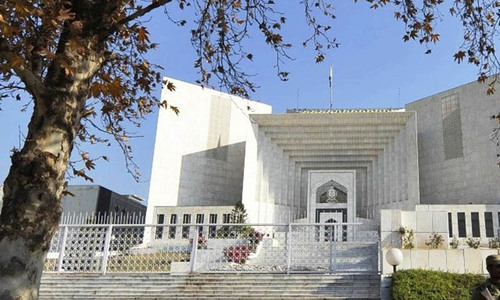
ISLAMABAD: The Supreme Court on Wednesday ordered the law secretary to immediately seek instructions from the government for setting up at least 120 accountability courts to clear a huge backlog of cases.
The directives were issued by the apex court after expressing dismay over 1,226 pending references since the year 2000 as well as vacancies in five accountability courts out of a total of 25.
“The whole purpose of making of accountability law apparently seems to be rendered futile if the courts are allowed to remain vacant,” regretted Chief Justice Gulzar Ahmed.
The chief justice was heading a three-judge bench that had taken up a suo motu case regarding delay in trials before the accountability courts in the light of Section 16 of the National Accountability Ordinance 1999 which asks for deciding corruption matters within 30 days.
The suo motu proceedings were initiated when Justice Mushir Alam on Jan 8 had requested the chief justice to constitute a special bench and initiate suo motu proceedings over the delay in prosecuting the accused before the trial courts.
The Supreme Court also cautioned that it expected that the law secretary would fill all the available posts of five accountability judges within one week without fail or the court would take coercive action against the officials found defaulting in the performance of their duties.
Earlier also on Feb 13, the Supreme Court had expressed concern over capacity issues plaguing the National Accountability Bureau (NAB) when it was told that 1,226 references were pending before accountability courts and five such courts were without any presiding judge.
“Neither the investigating officers working with the NAB are well trained to properly probe the corruption allegations nor the prosecutors are interested to pursue the cases before the accountability courts,” the chief justice had observed.
On Wednesday the Supreme Court observed that neither the attorney general nor the law secretary or the prosecutor general of NAB was in attendance. Besides, no reason was offered why the vacant posts had not been filled.
“We are unable to understand the rational or logic behind the courts vacant for long periods... More so when we see that the cases before the accountability court are to be decided in terms of law within 30 days,” the court order said, adding the posts of the judges were vacant for years and cases of those courts remained pending.
“The number of pendency of cases in the accountability court demand more than hundred number of judges/courts for dealing with and deciding these cases as such cases are being filed regularly and their numbers are also increasing while the number of courts are totally stagnant,” the apex court deplored.
“In these circumstances, we direct the secretary law to immediately seek instructions from the government on the proposal of creating at least 120 accountability courts in Pakistan and to fill up such courts with the judges and distribute all pending cases among these courts so that cases be decided at a fast pace and also in accordance with the time frame provided in the law,” the court said.
It noted that the application filed before the court by NAB showed that cases even of the years 2000 up to 2006 and onward were pending before the accountability courts and apparently there seemed to be no valid justification why these cases were being allowed to remain pending.
The court ordered the government to immediately increase the strength of the accountability courts all over Pakistan to ensure that all pending accountability cases came to a logical conclusion at a fast pace within three months.
The court also asked the AG to appear before it next week and directed the NAB prosecutor general to furnish a report, duly signed by the NAB chairman, explaining how the bureau proposed to deal with these pending cases and have them decided at the earliest.
The Supreme Court said that if such measures were not adopted by the government and NAB, the entire purpose of the NAB law would stand vitiated.
Published in Dawn, July 9th, 2020