0
0

ON the occasion of ‘World Food Day’ on October 16, the Environ Monitor of Pakistan is organizing a conference in Lahore in the first week of the month. A number of national and international scientists and experts are expected to participate with major emphasis on the prevailing food and beverage problems.
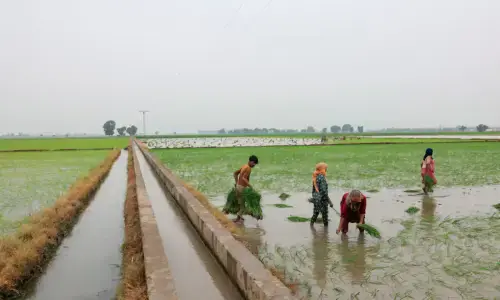
It is surprising that despite the presence of latest technologies for increasing production the country is confronted with the food shortage. Thus keeping in view the importance of the subject, some major causes of it are discussed in this article for consideration.
Pakistan is facing food problem due to the increasing population and declining water and land resources. This will grow manifold in the next decade thus burdening the national exchequer and adding to socio-economic problems if appropriate measures are not taken, immediately.
The mismanagement of agricultural resource bases and production system are major causes of food shortage. The population growth from 1951 to mid-80s was three per cent per annum, while from 1985 to 2000 it was 2.6 per cent and thereafter two per cent.
The population has increased from 33 million to 152.5 million in 50 years thus making Pakistan the seventh most populous country in the world. It is estimated that the population will rise to 168 million by 2010 and to 195.5 million by the end of the following decade, thus further aggravating the problem.
The country has imported wheat for 49 years out of its 58 years’ history and edible oil almost every year bringing its bill to $526.6 million in 2004-05. The import bill of food, live animals and their consumable bye-products in 2003 was Rs29,000 million and that of beverages and tobacco at Rs368 million, increasing it further, as of now.
Uncontrolled rise in population has lowered the per capita consumption of water from 5,000 to 1,000 cubic metres. The big cities are already facing drinking water shortage.
Nearly 50 per cent of the urban and 71 per cent of the rural population has no access to safe drinking water, resulting in deaths of hundreds of people and many suffering from water borne diseases such as cholera, typhoid, hepatitis, diarrhoea, dysentery, yellow fever and malaria.
Around 60 per cent of the infant mortality is associated with the water-related and parasitic diseases. The government needs to check its population growth rate as has been successfully done in China and other countries.
The falling surface of irrigation water resource due to politicalization of the construction of new dams, and the failure to apply modern technology at field level have resulted in crop reduction by 56-86 per cent.
The over-mining of groundwater from over 7,03,074 tube wells and the use of nearly 70 per cent of marginal to highly brackish groundwater have further compounded the situation. Of the total geographic area of about 79.6 million hectares (mha), around 70mha are arid and semi-arid.
About 18mha have been brought under irrigated agriculture suggesting that there is a vast scope of rain-fed agriculture on large area. For instance, of the present total cultivated area, nearly 24 per cent is rain-fed and there still are 9mha of culturable waste land which could be brought under the rain-fed agriculture.
The yield of our rain-fed crops is also below their achievable potential. Many countries are getting their rain-fed crop yields equal to the irrigated crops by following the rain water harvesting and conservation techniques. For instance, the rain-fed wheat contributes nearly 12 per cent of the total national wheat production but its yield per hectare is over 50 per cent less than the irrigated.
Similarly, our rain-fed croplands contribute to the national production 27 per cent maize, 52 per cent barley, 56 per cent sorghum and millets, 77 per cent of gram, 89 per cent pulses, 24 per cent rape and mustard, and 89 per cent groundnut but their yields too are far below their actual potentials. This reflects on our poor food crop production system
Inspite of spending billions of dollars taken in loans from the international funding agencies for reclamation of eroded, waterlogged, saline and sodic soils, there are over 11.2 million hectares of slightly too severely water eroded and over 4.7 million hectares of wind eroded soils.
Likewise, there are 6.2 million hectares of saline, saline–sodic and sodic soils, while there are 2.47mha of land with the water-table depth of 0-5 feet from the ground surface which seriously affects the crop production on such soils. There are 5.2mha of soils with water depth ranging from 0-10 feet from the ground surface.
Due to continued fragmentation of land, 68 per cent of total farmland or about 80 per cent of the cultivated area has become small, subsistent and below subsistent level farms where modern advanced technology for increased crop production cannot be effectively applied.
Various land reforms could not be effectively applied due to feudalism. Whereas, India has effectively controlled its feudal system by fixing a limit of land holding beyond which no further fragmentation can take place. As a result the yield of their major food crops is much higher than ours. For instance, the wheat yield of Indian Punjab and Haryana State are 50 per cent higher than that of our Punjab, the largest wheat growing province. This again reflects on the mismanagement of our land resource base and agricultural production system.
There are over 200 agricultural research institutes, stations and sub-stations in the country, but the yield of our food crops is not only far below their achievable potential but also ranks low in the world despite Pakistan having the largest irrigation system in the world.
For instance, the present yield gap between actual and potential yields of wheat is 72 per cent, rice (paddy) 80 per cent, maize 73 per cent, pulses 86 per cent and edible oilseeds 77 per cent.
Although Pakistan is the seventh largest country with respect to area under wheat, it ranks 59th in the world for yield per hectare. Likewise, Pakistan is the fourth largest country with respect to area under sugarcane but its yield is the lowest in the world. Similarly, our ranking of yield per hectare of other food crops is also very low.
With the exception of the Second Five-Year Plan, none of the Nine Five-Year Plans could achieve their targets. Even, the present Tenth Five-Year Plan is not without flaws. Many recommendations made in the national and international seminars and conferences held on various agricultural issues in Pakistan for increasing its food production to meet the future challenges were not implemented due to the powerful bureaucracy which is more interested in taking commissions on the import of food and other agricultural products.
Similarly, the support prices fixed by the government did not effect the national food production. For instance, the increase in support price of wheat during the last two years did not show any impact to meet the national requirements because the private sector paid higher price than the government announced support price and hoarded wheat to smuggle the commodity and its flour later to Afghanistan and other central Asian States to earn huge amount of money at the national expense. Consequently, the country is importing wheat to meet the food needs of its population. We are also importing other food items and beverages.
The food industry is engaging over 20 per cent of the country’s working population but it too faces several problems at the pre-establishment and post–production phases. Some of the problems are political changes, lack of financing capital, non-availability of skilled labour, lack of infrastructural facilities, low capacity utilization and machinery, transport problems, high production cost, etc.
Likewise, the dairy, livestock and poultry sectors, an important source of milk, milk products, meat, mutton, and eggs, are also facing various problems.
These are just few examples of mismanagement of our food production system. It is, therefore, essential that during the food day conference the participating scientists and experts should seriously consider these issues and prepare fool proof recommendations to make the country self-sufficient in food items immediately, and to sustain it in the future as well to meet the demands of the increasing population.