President Alvi outlines plan agreed with ulema on congregational prayers during Ramazan



President Arif Alvi on Saturday announced that congregational and Taraweeh prayers would be held during the month of Ramazan while adhering to precautionary measures to stop the spread of the coronavirus.
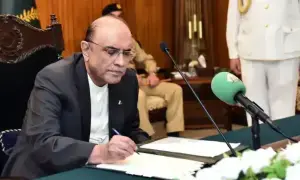
The president met with prominent ulema and religious leaders earlier in the day at Aiwan-i-Sadr to build consensus and form a plan for congregational prayers and Taraweeh during Ramazan.
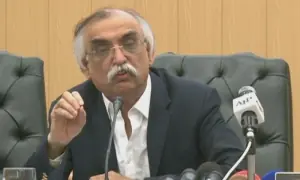
Speaking at a press conference in Islamabad after the meeting, the president said: "Ramazan is a month of worship and Muslims love this month a lot. It was necessary that government's recommendations and ulema's recommendations be collected before any decision was taken."
Alvi also revealed that a 20-point action plan had been decided upon jointly by the government and ulema. According to the plan:
- There would be no carpets in mosques and imam bargahs. People would be encouraged to bring their own prayer mats.
- Social distancing would be observed.
- People would be advised to refrain from discussions in mosques.
- Mosques which have compounds would hold prayers outside rather than inside the building.
- Elderly and sick people would not come to mosques.
- Taraweeh preparations would be made only in mosque premises, not on roads.
- People would be encouraged to offer Taraweeh at home.
- Mosque floors would be washed with chlorine disinfectants.
- Prayer mats would also be disinfected with chlorine mixture.
- Congregational rows would be formed with a 6ft distance between worshippers.
- Committees would be formed to ensure preventive steps are followed.
- Ablution should be performed at home.
- It would be necessary to wear masks at mosques.
- No handshakes or hugs would be allowed.
- Worshippers would refrain from touching their faces.
- People would be encouraged to perform aitekaf at home.
- No preparations for sehri and iftaari would be made in mosques.
- Mosque administration would remain in contact with local police and cooperate with them.
- Mosque administration and police would be asked to ensure social distancing is maintained during prayers.
- Government can review and change any part of its policy on mosques during Ramazan if these measures are not being followed or the rise in cases is exponential.
President Alvi urged citizens to follow these preventive measures, advising them that only those countries were successful where citizens did not follow rules by force but on their own initiative.
The president noted that after an ijma (unanimous consensus) between government and religious scholars on an action plan, not following the measures will be equivalent to sinning.
“When the government and scholars agree with consensus on something, such as preventive measures for congregational prayers during Ramazan, it becomes imperative for people to follow them,” he added.
He also appealed to the people to not reduce the amount of their monetary contributions in the form of zakat and sadaqah during Ramazan and to pray for their brethren in occupied Kashmir during the holy month.
The meeting with ulema was also attended by Interior Minister Brigadier (r) Ijaz Shah, PM's aide on health Dr Zafar Mirza and Religious Affairs Minister Noorul Haq Qadri.