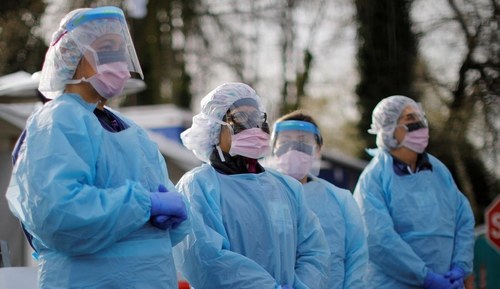
In epicentre of French virus outbreak, medical workers believe peak has passed


 1
1


As head of the urgent cases team in the Mulhouse ambulance service, Marc Noizet has been at the eye of the coronavirus storm that swept through this eastern French city. In the past few days, he has noticed a change.
“Things are getting better,” he said of the region around Mulhouse, the epicentre of France's deadliest outbreak. His crews are being called out to fewer coronavirus-related cases. “That allows the staff to rest a bit, to take a breath.”
Public health officials in the Grand-Est region, near France's border with Germany, Switzerland and Luxembourg, say it is premature to say the crisis is over, but they believe they have passed the peak of the epidemic.
The virus hit the region earlier and harder than anywhere else in France, in large part because of a five-day prayer gathering at an evangelical church in Mulhouse where dozens of worshippers were infected.
The more positive trend now could provide a roadmap for how other regions and countries still in the thick of the outbreak will eventually emerge.
The number of people in intensive care units in the Grand-Est region being treated for coronavirus is ticking down — as of Thursday it was 937 people, 13 fewer than a day earlier. That was the sixth consecutive day the figure had fallen.
The total death toll has kept rising this week, but the rate of increase has slowed. On the worst day of the outbreak, April 3, 141 people died. On April 9, 82 people died.
“We can say that we passed the peak,” said Laurent Tritsch, chief doctor of the fire and rescue service in the Lower Rhine, part of the Grand-Est region.
France as a whole has more than 86,000 confirmed cases of the new coronavirus and has registered more than 12,210 deaths, the fourth highest death toll in the world after Italy, Spain and the United States.
Turning point
For weeks, the number of new critical cases in the Grand-Est region was rising faster than beds were becoming available. Hundreds of sick people were evacuated by train, plane and helicopter to be treated in other parts of France or Europe.
According to Tritsch, whose service helps transport sick patients to hospital, the graph inverted on March 28, when new intensive care beds coming on stream outstripped the increase in critical cases.
On April 6, a medically-equipped French air force Airbus A330 stood on the tarmac at Luxembourg airport. Next to it were five ambulances that had brought coronavirus patients from the eastern French city of Metz. The pilot's mission was to fly them to the Czech city of Brno, where they were to be treated.
But the pilot received an order to abort the mission. French officials had decided there were spare intensive care beds in the Grand-Est city of Nancy, so the evacuation was no longer needed, according to a French government source.
Though a turning point has been reached, no one in the region is celebrating. Healthcare workers are exhausted after a month on constant duty, many of their colleagues are sick, and the virus could come back if restrictions on movement are relaxed, medical professionals say.
“We're not crying victory,” said Fabien Trabold, chief doctor of the Upper Rhine fire and rescue service.