First phase of single national curriculum completed, says govt

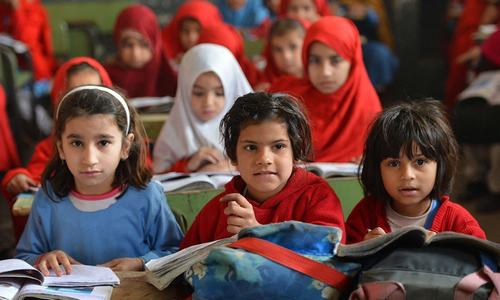
ISLAMABAD: The government has claimed to have completed the first phase of the implementation of the single national curriculum in the country by developing a uniform syllabus for class 1 to 5, but says it will take another year for its implementation in all educational institutions and madressahs [religious seminaries].
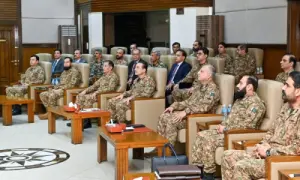
It was said at a meeting held at Prime Minister Office (PMO) on Thursday. Presided over by Prime Minister Imran Khan, the meeting was attended by Minister for Education Shafqat Mehmood.
The Pakistan Tehreek-i-Insaf (PTI) dreamt of implementing a uniform curriculum in the whole country when it came into power after the 2018 general elections. But, it would take three more years to fulfil this promise as according to the PMO implementation on it will be completed in 2023, the year in which the next general elections are scheduled to be held.
The PMO said the prime minister was apprised that under the phase-I, uniform curriculum for class 1 to 5 had been developed and its implementation would be completed by March 2021.
The phase-II curriculum for class 6 to 8 would be ready by March 2021 and implemented by March 2022, while the phase-III curriculum for class 9 to 12 would be ready by March 2022 and enforced by March 2023.
Uniform syllabus for class 1 to 5 will be implemented in a year, meeting chaired by PM informed
The prime minister was told that among extensive stakeholders’ consultations, four-day workshops were conducted in all the provinces in which more than 400 experts participated, including members of the Ittehad Tanzeem-ul-Madaris.
The meeting was informed that the nation’s school education system and curriculum were divided into three streams, private education largely English medium, foreign certification, state schools (largely Urdu medium, including madressahs and Dars-i-Nizami).
The meeting was told that a system of winners (the elite class) and losers (the rest) existed in the country and that the entire socio-economic system supported the elite class.
The prime minister was informed that there was a difference of mindsets in the country and different curriculums were being implemented that caused a fractured national psyche.
The meeting was also informed about measures being taken to control the spread of novel coronavirus in educational institutions. It was informed that a special educational transmission of seven-hour duration would be broadcast by the Pakistan Television so that students could continue their education at the home.
Speaking on the occasion, Prime Minister Imran Khan said that the aim behind enforcement of a uniform educational curriculum was to equip the young generation to cope with challenges of the technological age and to instil in them social values that highlighted a distinct national character.
The prime minister emphasised that the teachings of Holy Prophet Muhammad (Peace be upon him), guidelines of Quaid-i-Azam Mohammad Ali Jinnah and the philosophy of Allama Muhammad Iqbal should be made part of the curriculum. He also highlighted that the curriculum should cater to the needs of modern times.
The prime minister directed that the “mafias” role should be eliminated during publication of uniform curriculum textbooks. He assured full support of the federal government in implementation of the uniform education system in the country.
The meeting was told that the present class-based education system had not only divided the educational institutions, education standard, teachers and students, but it had also created a system based on the whole social and economic structure, which was serving the interests of a particular class. The system was creating a diverging mind-set in society, which had caused a divided national consciousness and psyche.
The meeting was informed that the present government after coming into power formed the National Curriculum Council, comprising representatives from all the federating unites, besides famous personalities from the private sector and religious seminaries.
It was briefed that implementation of the uniform curriculum for educational institutions and its evaluation had remained one of the important elements of the PTI’s election manifesto. The rationale behind the decision was to eliminate the disparity between curriculum, facilities, mediums of instruction, teachers and students performance, which had resulted into differing mindsets causing a fractured national psyche.
Published in Dawn, March 20th, 2020