14
14
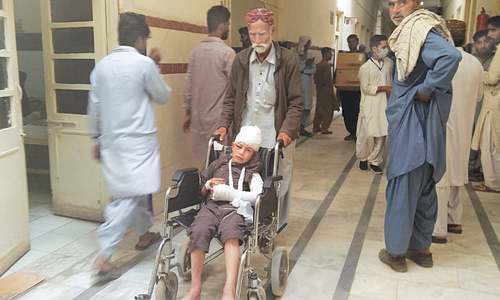
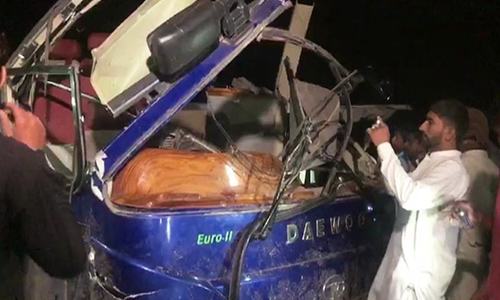
FRIDAY’S tragic accident in which at least 20 people lost their lives after a train rammed into a passenger bus at an unmanned crossing near the Rohri railway station in Sindh could have easily been avoided. The death toll is likely to rise with many wounded bus passengers in precarious condition.
This is not the first time that an unmanned crossing has been the scene of a deadly collision between a train and a bus. Given that there are as many as 3,000 unmanned crossings in the country, we cannot rule out similar occurrences in the future. In fact, collisions at unmanned crossings are perhaps the main cause of deadly train accidents here. The sad part is that, instead of taking steps to prevent such accidents, the tragedy is now being used to score political points.
For instance, it would have been much better for Railways Minister Sheikh Rashid to have directly approached the Sindh government to address the issue of unprotected crossings rather than starting a blame game during his news conference on Saturday. He must not forget that the buck will always stop at his door as railway minister and his performance will come under public scrutiny whenever there is a railways disaster on his watch.
Even if the minister is not ‘directly’ to blame for the latest incident, the people are well within their rights to ask him what his ministry has done to prevent train accidents that occur frequently because of its negligence. Pakistan has a long history of train accidents mainly because of poor infrastructure and the absence of safety standards.
The vast majority of accidents take place because the railways has not invested in infrastructure. In 2019 alone, there were over 100 train accidents, including a fire that engulfed three coaches of the Tezgam in October. More than 70 people died.
The number of train accidents also includes derailments, something a senior railway official recently described as ‘normal’. It is unfair to blame the incumbent government for the mess the railways is in. Yet this government was expected to pay more attention to stop further decay of the railways and improve its overall performance. The prime minister had announced in July that additional funds would be allocated for the proper maintenance of the railways infrastructure, and that officials responsible for neglecting the safety of the passengers would be held to account. Action on that promise is still awaited.
Published in Dawn, March 1st, 2020