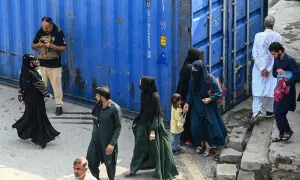
NEXT week, Pakistan will host a conference along with the United Nations High Commissioner for Refugees on the status of Afghan refugees in the country as a timely reminder to donor nations and international aid agencies to live up to their promises. The event will be attended by the UN Secretary General António Guterres and UNHCR chief Filippo Grandi. Last year, several donor countries (including the US) had taken a pledge to do all they could to help in the repatriation of Afghan refugees — with all the dignity and respect that these displaced families deserve — and yet, it seems as if the global community keeps forgetting about the plight of the second-largest refugee population in the world, along with all the promises it has made to them. The issue is especially relevant given the current talks taking place among Afghanistan’s various stakeholders since one cannot help but wonder: where do the millions of Afghan refugees fit in this so-called peace plan? Given that the world, including the former and present superpowers, have contributed to the countless challenges faced by the Afghans it is only fair they play their part to help solve their problems now. The Afghans have suffered multiple wars, invasions and militarisation, and have seen foreign actors fight for their own vested interests through the use proxies over the years, resulting in a steady stream of refugees escaping violence and poverty to seek sanctuary in other lands. For decades, Afghanistan has been described as ‘war-torn’. This has remained its greatest tragedy and given rise to a host of other malaises.
In 2019, the BBC reported that an average of 74 Afghans were killed per day in the month of August alone — three times higher than in the more recently declared ‘war-torn’ countries of Syria and Yemen. As long as Afghanistan is wreaked by violence, terrorism and religiously inspired militancy, there is little hope that any solution carved out for its refugee population will prove long-lasting. Till last year, there were an estimated 1.4m documented Afghan refugees living in this country. Despite various repatriation programmes, their numbers have been consistently high and many of those who live in Pakistan are still undocumented. In accordance with the laws, those born in the country are supposed to be awarded citizenship, yet this has often not been the case and millions are forced to live a life of uncertainty.
Published in Dawn, February 13th, 2020