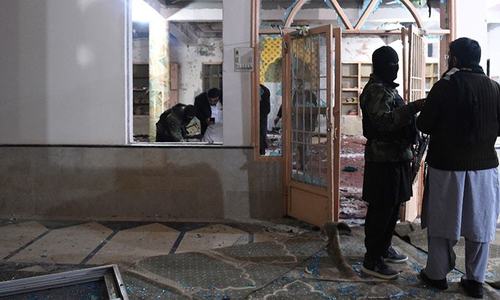
BALOCHISTAN is, unfortunately, no stranger to violence, though various acts of terrorism perpetrated by a variety of militant actors in the province have dipped in frequency over the past few years. But as Friday evening’s tragic bombing in a Quetta mosque has shown, the calm in Balochistan is tenuous.
Unless the security forces continue to keep a keen eye on militants in the province, a return to the bad old days cannot be ruled out.
At least 15 people lost their lives in the blast, including senior police officer DSP Amanullah Ishaqzai; the tragedy for his family was compounded as he had recently lost a young son in an apparent targeted killing. This is the second major act of terrorism in Balochistan over the past several days, as on Tuesday, Hizbul Ahrar, a proscribed offshoot of the TTP, claimed responsibility for a bombing that targeted a Frontier Corps vehicle in Quetta’s Mecongi Road area. As for Friday’s attack, the militant Islamic State group has claimed responsibility.
Though the motive of the mosque bombing is not yet clear — the targeting of a senior police officer is a possibility — other factors may also be involved.
For example, the violence could be a spillover of the struggle between two major Afghan militant actors, the Taliban and the local chapter of IS.
As reported in this paper, an investigator has said Friday’s incident bore resemblances to the bombing in Kuchlak last year, in which a brother of Afghan Taliban chief Haibatullah was killed.
Both the Taliban and the IS Khorasan outfit are locked in a battle for influence within Afghanistan, and it would not be unusual for their sparring to cross into Pakistan, as both have ideological comrades on this side of the border.
In order to preserve the relatively peaceful atmosphere in Balochistan, better intelligence is needed to shield Pakistan from violence originating in Afghanistan.
Balochistan in the past has seen waves of bloodshed carried out by militants — the massacre of the province’s Hazaras by Lashkar-i-Jhangvi should not be forgotten — while the Baloch separatist insurgency is also largely quiet at present.
Therefore, with the state saying that calm has been restored in the country, Balochistan cannot be allowed to slip back into chaos.
Solid intelligence-based operations are needed to trace out local facilitators of Afghan militant groups and neutralise them before they can use Pakistani soil as a battlefield in their proxy war.
Published in Dawn, January 12th, 2020