0
0


The Mohatta Palace Museum recently opened an exquisite collection of portraits made by the British artist Henry Charles (abbreviated to Hal) Bevan Petman. The exhibition, titled Staying On: the Art of Hal Bevan Petman, and co-curated by Nasreen Askari and Romano Karim Yusuf, is a feast of skill in portraiture and a documentation of post-Partition social affluence. Loaned for this exhibition by the private collections of those portrayed by Petman in the 1950s, ’60s and ’70s.
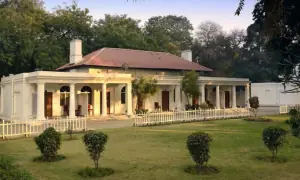
The most engaging aspect of the collection is the curators’ careful consideration to and integration of contextual information and artworks. Displaying a relatively small number of paintings, as opposed to large-scale exhibition projects held previously here, these paintings are housed with meticulous attention within the befitting opulence of the museum. The show exudes a grand sense of celebration.
Hal Bevan Petman’s oeuvre showcases a forgotten sensibility in the art of portraiture
Petman received his early training in art from the Slade School of Fine Art in London, known for its classical approach to art and its focus on high realism and figuration. He came to India in 1921 and travelled to Lahore, Delhi and Simla to work on commissioned portraits of the rich. In 1940, he married Beryl Dyer, who was brought up in Lahore and they settled in Lahore. In the years after 1947, the artist travelled to Muree and Bhurban in the summers to paint his subjects. He was also given several commissions by the army, and he made the Rawalpindi Club his base. Petman died in 1980 and is buried in the Christian graveyard in Rawalpindi.
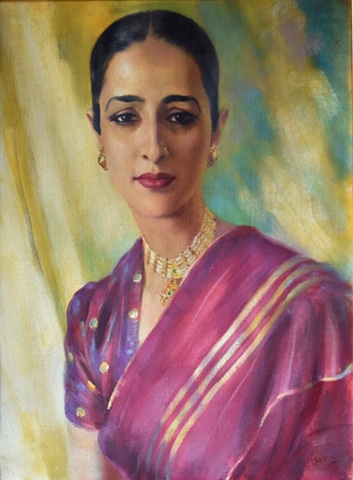
On view in the Mohatta Palace Museum are portraits of Major Raza (Shaheed), and of several high ranking officials, among them the young Sahabzada Yaqub Khan. Petman painted the beautiful ladies of elite families in a highly complementary manner, making them appear glossy and glamorous. The artist was visibly mesmerised by the beauty and style of his patrons.
The subjects appear to have posed for him in their finest attire and bejewelled, accentuating their affluence. In fact, as one viewer remarked, that this is like a ‘Barbara Cartland’ sort of depiction. The paintings, although in oils, are light enough in treatment as watercolours, with a background of flowing colours, suggest a joyous time and place.
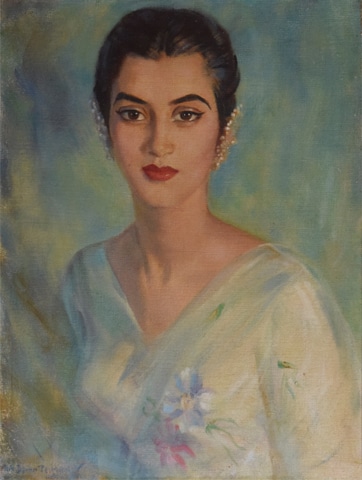
This exhibition opens a subtle window on the colonial mindset and the nature of ingrained social values. For example, Petman chose to portray only the beautiful ladies in elegant saris and hairstyles of the ’60s and ’70s, and handsome men in suits which presents a very ‘Gora Sahib’ face of society. This is a European depiction of the post-Partition generation, which happens to be an understudied subject in visual arts.
The curators link Petman to the convention of portraiture by Fayzee Rahamin. Rahamin was from Bombay and a student of the Royal Academy of Arts in London and tutored by John Singer Sargent, the famous British portrait painter. He painted in Sargent’s style and modified it to suit Indian patrons of Western art.

According to Dr Akbar Naqvi, Rahamin painted Indian princesses to make them look like Grecian beauties. Interestingly, Petman painted his ‘Indian’ subjects with European features, in all probability, to cater to their desire to project themselves as such.
These are critical junctures in the history of art, and exhibitions such as the current one help us see ourselves from a distance. In all cases, one cannot but marvel at the painterly flow of Petman’s brush and his impeccable sense of colour and attention to detailing. This exhibition is a celebration of beauty and the timeless sensibility of high realism.
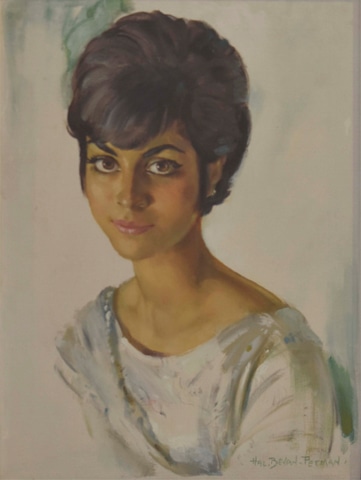
“Staying On: The Art of Hal Bevan Petman” is being displayed at the Mohatta Palace Museum, Karachi from December 10, 2019 to June 10, 2020
Published in Dawn, EOS, December 29th, 2019