US lawmakers take offence at India’s attempt to pressure Congress


WASHINGTON: “It’s wrong for any foreign government to tell Congress what members are allowed in meetings on Capitol Hill,” said Senator Kamala Harris when India’s External Affairs Minister S. Jaishankar refused to attend a meeting with American lawmakers because Congresswoman Pramila Jayapal was also on the guestlist.
Congresswoman Jayapal and Senator Harris, who dropped out of the Democratic presidential race early this month, both have an Indian background. Senator Harris’s mother was from Chennai while Ms Jayapal was born there.
Yet, Mr Jaishankar refused to meet Ms Jayapal when the Indian Embassy arranged a meeting for him with the House Foreign Affairs Committee in Washington earlier this week to share India’s views on Kashmir with the members.
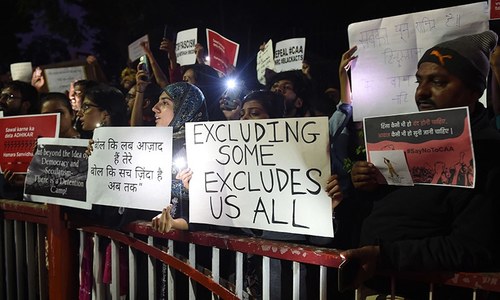
Ms Jayapal, who is a member of the panel’s subcommittee on Asia and the Pacific, rejects the Indian position on Kashmir and accuses New Delhi of committing gross human rights violations in the occupied valley. She also criticises India’s new citizenship law because she believes it discriminates against Muslims.
Recently, Ms Jayapal moved a resolution in Congress urging India to end restrictions on communications and mass detentions in the occupied Kashmir as swiftly as possible and preserve religious freedom for all residents. “I’m deeply concerned. Detaining people without out charge, severely limiting communications, & blocking neutral third-parties from visiting the region is harmful to our close, critical bilateral relationship” with India, she wrote in a recent tweet.
According to US media reports, when informed that Ms Jayapal would also attend the meeting, Mr. Jaishankar asked his aides to ensure that she is kept out. He was particularly upset with Ms Jayapal for sponsoring the resolution that condemned India’s crackdown in Kashmir.
But when Mr Jaishankar’s emissaries contacted Congressman Eliot Engel, chairman of the House Foreign Affairs Committee, to remove Ms Jayapal from the list. Mr Engel refused, and the meeting was cancelled.
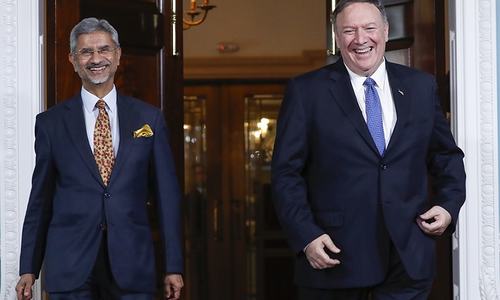
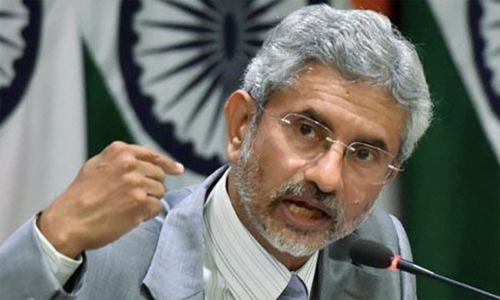
Mr Jaishankar, who was in Washington for US-India strategic dialogue, however, defended his stance. “I am aware of that resolution. I don’t think it’s a fair understanding of the situation in Jammu and Kashmir or a fair characterization of what the government of India is doing. And I have no interest in meeting (Jayapal),” said the Indian leader while talking to the media. Ms Jayapal, the first Indian-American woman elected to the House of Representatives, however, described the cancellation as “deeply disturbing” and said in a tweet that “it only furthers the idea that the Indian government isn’t willing to listen to any dissent at all.”
Ms Harris, the first US Senator of Indian origin, said she stands with Ms Jayapal. “I’m glad her colleagues in the House did too,” she added.
Senator Elizabeth Warren, a leading Democratic presidential candidate, also supported Ms. Jayapal, saying that “efforts to silence” a US lawmaker “are deeply troubling”. She retweeted a report by The Washington Post which said Mr Jaishankar refused to attend a meeting of House Foreign Affairs Committee members that included Ms Jayapal.
“Shutting out US lawmakers who are standing up for human rights is what we expect from authoritarian regimes—not the government of India,” said another leading candidate, Senator Bernie Sanders.
“Representative Jayapal is right. She must not be excluded for being outspoken about the unacceptable crackdown on Kashmiris and Muslims,” he added in his tweet.
Congressman Jim McGovern, also a Democrat, said “no foreign government should dictate who is or isn’t allowed into meetings on Capitol Hill.” He also “applauded” Congressman Engel for not succumbing to the Indian pressure.
Published in Dawn, December 23rd, 2019