No flag, constitution for held Kashmir under its new status



SRINAGAR: India on Thursday formally implemented the decision it announced in early August which removes occupied Kashmir’s semi-autonomous status and begins direct federal rule of the disputed area amid a harsh security lockdown and widespread public disenchantment.
Its legislation divides the former state of Jammu and Kashmir into two federally governed territories. Government forces were on Thursday on high alert to prevent anti-India protests or armed attacks, though no incidents were reported until noon.
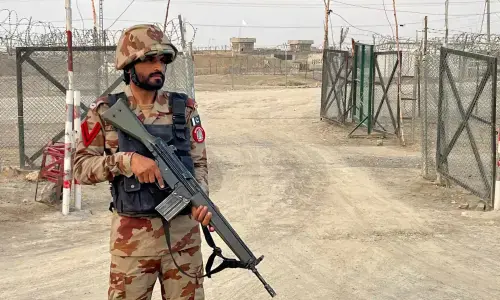
Tens of thousands of police and paramilitary soldiers fanned out across the disputed region, patrolling streets and manning checkpoints. Shops, schools and businesses have mostly remained closed since August and streets were largely deserted.
Mehbooba Mufti urges the Indian government to engage with Kashmiris ‘before it’s too late’
G.C. Murmu, a new civilian administrator appointed by Prime Minister Narendra Modi’s government with the title of lieutenant governor, assumed office on Thursday. The region previously was headed by a governor.
Indian authorities also changed the name of the state-run radio station Radio Kashmir Srinagar to All India Radio Srinagar. The radio started broadcasting even before India gained independence in 1947.
The most visible change is the absence of Kashmir’s own flag and constitution, which were eliminated as part of the disputed region’s new status. But the most contentious point for many people is the threat of land grabs by Indians outside the region with the formal abrogation of a clause in the Indian Constitution that safeguarded Kashmiris’ exclusive right to land ownership.
“Everything changes on Thursday. From a state, we are reduced to a municipality,” said a retired Kashmiri judge, Hasnain Masoodi, a member of India’s parliament.
“The entire exercise is unconstitutional. The mode and methodology have been undemocratic. People were humiliated and never consulted.”
Masoodi represents the National Conference, a powerful pro-India Kashmiri political group whose leaders have been detained.
‘Left in the lurch’
Former Jammu and Kashmir chief minister Mehbooba Mufti, one of scores of politicians in detention to prevent large protests from breaking out, said the Indian government must engage with Kashmiris before they become even more alienated.
“GOI (government of India) has left Kashmiris in the lurch & shown disregard for their rights. But if you consider them as your own, reach out & engage with them before it’s too late,” she said in a Twitter post which is being handled by her daughter Iltija.
Despite a siege by tens of thousands of Indian security personnel, hundreds of anti-India protests and clashes have erupted across the Himalayan region. Government forces have fired tear gas, shotguns and firearms to prevent stone-throwing protesters from marching in the streets, leaving at least three people dead and hundreds injured.
At least 4,000 people, mostly young men, had been arrested since the security lockdown was imposed in the first week of August. Indian officials say at least 3,000 have since been released.
About 250 of those still being held have been moved to various Indian jails outside Kashmir.
Records show that about 300 of those are being held under the Public Safety Act, which allows authorities to detain people for up to two years without trial.
Rayees Ahmad, a businessman, wondered how long India would be able to control Kashmir. “Time will prove that this situation will not remain,” he said.
“The world is watching.”
Kashmiri people’s hopes rest with India’s Supreme Court, which is set to begin hearings in early November on petitions challenging the validity of the abrogation of Article 370 of the constitution, which gave a special status to Kashmir. A decision is expected within several months.
Published in Dawn, November 1st, 2019