Lebanese take to streets for 10th day, defying Hezbollah


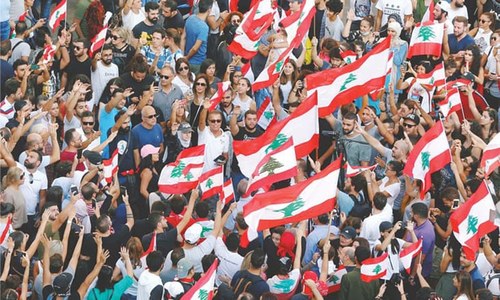
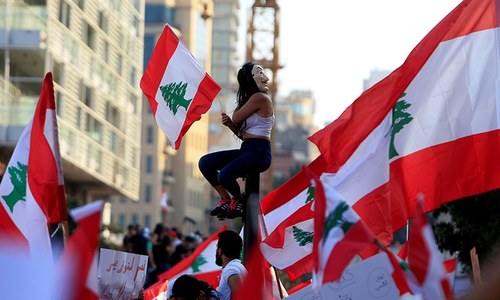
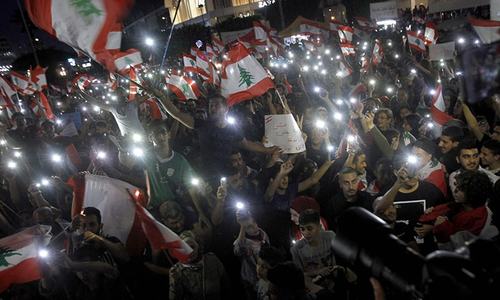
BEIRUT: Demonstrators across Lebanon blocked roads and took to the streets on Saturday for a 10th consecutive day, defying what they said were attempts by Hezbollah to defuse their movement and despite tensions with the army.
The demonstrators — who have thronged Lebanese towns and cities since October 17 — are demanding the removal of the entire political class, accusing many across different parties of systematic corruption.
Numbers have declined since October 20, when hundreds of thousands took over Beirut and other cities in the largest demonstrations in years, but could grow again over the weekend.
The chief of the powerful movement Hezbollah on Friday called on his supporters to leave the streets, warning that any cabinet resignation would lead to “chaos and collapse” of the economy. His statement sowed divisions among Hezbollah supporters, some of whom were still protesting on Saturday.
Hassan Koteiche, 27, from a Hezbollah stronghold in Beirut, said he agreed with most of Nasrallah’s “excellent” speech, but had some reservations.
“This does not mean we are against his discourse but there is a divergence in opinion,” he said.
“The main thing I disagree with is his belief that if the government or parliament falls then we would have no alternative,” he added.
“That is not true. We have alternatives. We have noble and uncorrupt people,” who can govern.
Main roads remained closed across the country on Saturday morning, as the army tried to reopen key routes.
The General Security agency — one of Lebanon’s top three security bodies — said it has started to implement a plan to open key roads.
An army spokesman said that security forces would negotiate with protesters, without resorting to violence.
But troops clashed with residents of the Beddawi area near the northern port city of Tripoli as they were trying to close a main road, according to the state-run National News Agency.
A medical source in the area said that at least four people were wounded by live fire and seven others in confrontations with the army.
Soldiers fired rubber bullets in the air after being hit with fireworks and stones, according to the spokesman.
Northeast of Beirut, dozens of demonstrators formed a human chain to prevent the army from removing a dirt berm blocking a seaside road.
In central Beirut, they sat cross-legged on a key artery that connects the capital to its suburbs and surrounding regions.
Demonstrators who had slept in tents near Martyrs Square, said they were still defiant. “We will stay on the streets,” said Rabih al-Zein, a 34-year-old from the Shia stronghold of Tyre in southern Lebanon.
“The power of the people is stronger than the power of the parties,” he said.
Lebanon’s largely sectarian political parties have been wrong-footed by the cross-communal nature of the mostly peaceful protests.
Waving Lebanese flags rather than the partisan colours normally paraded at demonstrations, protesters have been demanding the resignation of all of Lebanon’s political leaders. “All of them means all,” has been a popular slogan.
In attempts to calm the anger, Prime Minister Saad Hariri has pushed through a package of economic reforms, while President Michel Aoun suggested banking secrecy should be lifted from the accounts of high-ranking officials.
Ministers and lawmakers affiliated with the president’s Free Patriotic Movement are set to lift banking secrecy from their own accounts next week, according to an FPM statement.
Published in Dawn, October 27th, 2019