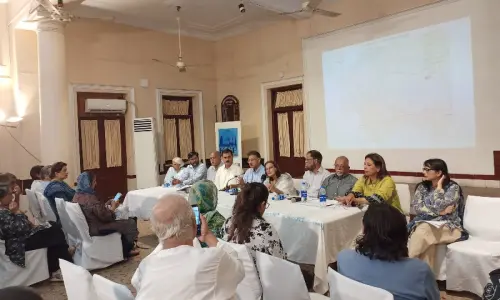
KARACHI: Speakers at a seminar held on the Bahria University-Karachi campus (BUKC) on Monday identified growing coastal and marine pollution, lack of mechanisms to ensure supply of good quality fish to the market and climate change as major challenges being faced by Pakistan’s blue economy.
Titled ‘Promoting Maritime Fisheries in Pakistan — Opportunities, Challenges and Way Forward’, the event was aimed at bridging the gaps between education and research in the field of maritime sciences.
It provided a platform to technical experts and scholars to discuss issues pertinent to marine fisheries and aquaculture that could help bring about socio-economic development in the coastal communities and improve the sector’s contribution to the economy.
In his welcome address, retired rear admiral Mukhtar Khan, the BUKC director general, highlighted the socio-economic and environmental issues of Pakistan’s blue economy.
He also informed the audience about the role the university was playing in tackling these challenges and said it had taken the initiative to develop relevant human resource by establishing the School of Maritime Sciences.
“It is to become a role model in higher education and research in the field of maritime sciences,” he said.
Spokesperson for Balochistan Chief Minister Azeem Khan Kakar underscored the need for holding such programmes on a regular basis saying such initiatives brought experts together on one platform, created awareness of Pakistan’s blue economy and its impact on the country’s development and guided the government on policymaking.
Consul General of Japan in Karachi Toshikazu Isomura, the guest of honour, expressed strong commitment on behalf of his government towards development of the fisheries’ sector in Pakistan as well as coastal clean-up efforts.
Some of the most important issues discussed at the forum included the effects of climate change on Pakistan’s blue economy, the need for coastal clean-up efforts, readjustment of supply-chain management for more hygienic fish handling and efficient transport and development of aquaculture for improved fish farming.
Head of the School of Maritime Sciences at the BUKC Dr Asif Inam in his concluding remarks urged the relevant authorities to undertake regular surveys for the stock assessment of fisheries’ resources and for obtaining oceanographic and meteorological data.
The speakers included National Fisheries Consultant FAO-Pakistan Waseem Khan, Mohammad Moazzam Khan, representing the World Wide Fund for Nature-Pakistan; Khalid Mehmood, representing the Fisheries Development Board, and Dr Shahid Amjad, heading the Environment and Energy Management Department of the Institute of Business Management.
Published in Dawn, October 22nd, 2019