PHC declares internment centres in KP unconstitutional

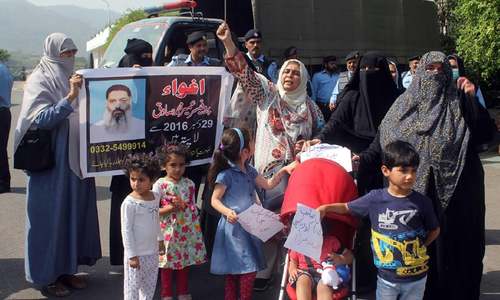
PESHAWAR: A Peshawar High Court (PHC) bench on Thursday declared as unconstitutional the functioning of scores of internment centres in Khyber Pakhtunkhwa after merger of the erstwhile Federally Administered Tribal Areas (Fata) and Provincially Administered Tribal Areas (Pata) into the province.
The bench of Chief Justice Waqar Ahmad Seth and Justice Mussarat Hilali also directed the province’s inspector general of police (IGP) to take control of the centres within three days.
The court asked the IGP to constitute a committee for scrutinising the case of each internee. The internees against whom there was no case should be set free whereas the cases that had already been registered should be referred to normal courts, said the bench.
After lengthy arguments by lawyers representing several petitioners and the province’s Advocate General Shumail Ahmad Butt and Additional Attorney General Qazi Babar Irshad, the bench declared as unconstitutional the controversial Action (in Aid of Civil Power) Ordinance 2019, which was promulgated by the province’s governor on Aug 5, and the two similar regulations of 2011.
Asks IGP to take control of the centres in three days
The bench also held as unconstitutional the KP Continuation of Laws in Erstwhile Pata Act, 2018 and the KP Continuation of Laws in Erstwhile Fata Act, 2019, through which the provincial government had given legal protection to the laws in force in former tribal areas at the time of their merger into the province.
The bench issued a short order and said a detailed judgement would be released later.
While different petitions were filed by detainees held at the internment centres, two of the petitions were filed by Advocate Shabbir Hussain Gigyani that challenged multiple laws, including the KP Action (in Aid of Civil Power) Ordinance, 2019, KP Continuation of Laws in Erstwhile Pata Act, 2018 and KP Continuation of Laws in Erstwhile Fata Act, 2019.
In May, Mr Gigyani initially filed a petition requesting the court to declare as null and void the KP Continuation of Laws in Erstwhile Pata Act, 2018 and KP Continuation of Laws in Erstwhile Fata Act, 2019 — wherein were all the laws, regulations, rules, notifications, including the Action (in Aid of Civil Power) Regulation, 2011, that were applicable in the former tribal areas.
He had requested the court to declare as unconstitutional the internment centres established under the 2011 regulations and to direct the government to hand over all the internees to the respective courts of competent jurisdiction for their trial as per the law.
Subsequently, Mr Gigyani challenged the impugned ordinance, contending that all citizens of Pakistan were equally placed and there was no rational basis on which people of the province could be distinguished from those living in the other parts of the country.
The provincial home secretary had issued a notification on July 20, 2011, through which nine detention facilities, where hundreds of suspected militants had been detained, were notified as internment centres in the province.
Similarly, another notification was issued by the additional chief secretary, Fata, on Aug 12, 2011, under which around 34 internment centres were notified in the former Fata. Through that notification all the forts of the Frontier Corps and political lock-ups in the seven tribal agencies (now districts) were declared internment centres.
Advocate General Butt opposed the petitions and contended that no interned person could be subjected to torture.
Mr Gigyani said that after the passage of the Constitution (Twenty-Fifth Amendment) Act, 2018 the people of former tribal areas could not be treated differently than those in the rest of the province and the country.
Published in Dawn, October 18th, 2019