THE wheels seem to be turning faster and faster at the top amid an accelerating slowdown in the economy.
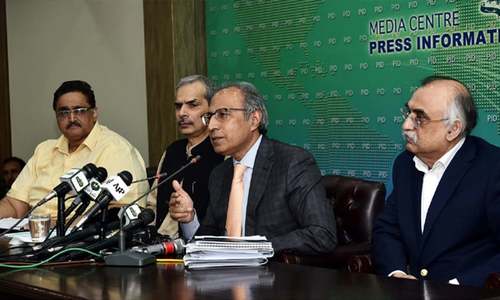
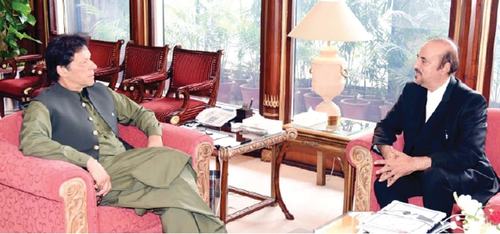
In two days alone, we have seen a high-level meeting at the prime minister’s residence to take stock of the economic situation, and a rare press conference by the prime minister’s adviser on finance, Hafeez Shaikh, during which the latter attempted to persuade his audience that the economy was on the right track and its deficits were reducing.
Read: Accountability should not affect business: Hafeez
It was also acknowledged that the accountability process could be hurting business confidence and a wish was expressed for NAB to continue its work in a “manner that does not negatively affect the business climate”.
While this remark and similar statements of late have led some to ask whether the accountability process will continue in its present shape, the government’s pursuit of political rivals accused of corruption has not halted.
The deficits in the economy are undoubtedly shrinking, and Mr Shaikh is right to point out that the size of the imbalances is reducing. He is also right to take a stand on tax collection and the documentation drive that is presently under way.
The actual revenues from the drive will be a while materialising, but a culture of compliance needs to be built, and if the vigorous hunt for non-compliant parties is what it takes to deliver results, then so be it, provided of course that certain lines are not crossed and the authorities do not resort to harassment.
But Mr Shaikh was premature in urging the people to take heart and asserting that the results of the decisions taken under the IMF programme had begun to come in.
For the people, whether the common man or the investor, results do not mean shrinking deficits. What the people are looking for is a check on inflation, improved job and investment opportunities, a tax burden that does not eat into one’s essential spending, and so on. Material improvements in the lives of the public and getting the rusty wheels of the economy to start turning again are the real deliverables of economic policy, and not shrinking deficits and changing ratios.
Mr Shaikh also pulled a small surprise for everyone by suggesting that the National Bank of Pakistan could be transferred into private hands. If so, this could be one of the biggest-ever privatisation deals. The list of heads from where the government is expecting to receive up to Rs1tr in non-tax revenue also threw up a number of caveats. For example, Rs400bn as State Bank profit hinges on the exchange rate remaining stable throughout the fiscal year.
Everybody wants to see the economy improve, but more importantly, everybody wants to feel that improvement in their day-to-day lives.
Published in Dawn, September 17th, 2019