Accountability should not affect business: Hafeez


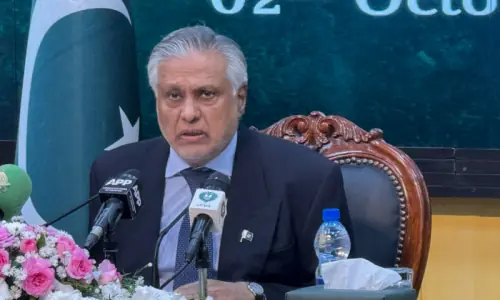
ISLAMABAD: Adviser to the Prime Minister on Finance and Revenue Dr Abdul Hafeez Shaikh has expressed the desire that the accountability process should progress in such a manner as does not negatively affect the business climate as the country is graduating from economic crisis to stability due to “hard decisions” taken by the government.
Speaking at a news conference on Sunday, the adviser hinted at addition of two profitable financial institutions — National Bank of Pakistan (NBP) and State Life Insurance Corporation (SLIC) — to the list of fast-track privatisation to improve their productivity and potential.
The adviser also said that an inter-agency body was in place to ensure effective implementation of anti-money laundering decisions to help the country get out of the Financial Action Task Force (FATF) grey list.
He conceded that stability and certainty had not yet reached a level that triggered foreign and domestic investment, as ‘people normally wait for a certain level of certainty in taking big decisions’. But the government was taking steps in that direction with the result that the cost of doing business had reduced, the level of corruption decreased and exchange rate, stock market and foreign exchange reserves stabilised, he added.
PM’s aide says NBP, State Life Insurance may go under hammer; efforts under way to get out of FATF grey list
Responding to questions regarding harassment of executives and bureaucrats by anti-corruption agencies, Mr Shaikh said businesses were more important than the government, because the former generated job opportunities and economic activities that the government supported through its policies. “I wish accountability agencies do their job in a manner that does not negatively affect the business climate,” he said.
On its part, he said, the government’s key goal was to improve conditions for investors and businessmen and hence it was taking a series of measures towards Ease of Doing Business while exporters were being offered subsidy in electricity, gas and facilitated for taking bank loans. He claimed that the country had moved out of the crisis inherited by the present government and was gradually turning to stability. “It is not possible to suddenly reach the goalpost so quickly after the crisis,” he added.
Inflation, tax
Mr Shaikh said inflation was a major challenge though its prevailing rate was ‘lower than expectations’. He said the top priority of the government was to reduce inflation through various measures including a freeze on borrowing from the central bank, reduced or no duties on raw material imports, passing on the benefit of lower international oil prices to consumers and ban on export of key commodities.
He claimed that the government was taking all steps in the interest of people and confronting every lobby and vested interest that hinders the documentation drive that increased the number of tax return filers from 1.9million to 2.5million. “We will provide every facility to the businesses but there would be no compromise when it comes to tax payment. The people should now have confidence that results of tough decisions taken by the government have started to accrue,” he reiterated, explaining that international players such as the International Monetary Fund, the World Bank, the Asian Development Bank and others were coming in aid of the government.
‘10 new firms on privatisation list’
Dr Shaikh said the government had reactivated the Sarmaya Pakistan Company for fast-track restructuring of 20 loss-making public sector entities and put 10 new companies to the privatisation list and issued their advertisements for fast-track sale process. He said the power sector companies particularly distribution companies (Discos) were being prepared for privatisation. Also, large well performing entities like NBP and SLIC who could not improve further on their own would also be considered for speedy transfer to the private sector to achieve their true potential.
When reminded that Pakistan Tehreek-i-Insaf had opposed the privatisation of state-owned enterprises and supported agitation when the previous government had planned offloading them and why he expected the current opposition to act otherwise, Dr Shaikh said: “Every opposition had the right to oppose good things.”
But he said there should be no problem when transactions were carried out in transparent and efficient manner while protecting the rights of the workers. He said as former privatisation minister he had completed a record 34 privatisation transactions with over $5bn in proceeds and most of those companies were in front of all to see their performance.
He said the government expected about Rs1 trillion in non-tax revenue this year through Rs200bn flows from cellular companies, Rs400bn from State Bank of Pakistan profits provided exchange rates remained favourable and Rs300bn from the sale proceeds of two RLNG-based power plants.
He said this would help reduce loans and provide funding for public welfare. Simultaneously, he added, the government was keeping a tight control on expenditures and had not approved any supplementary grant during the current fiscal year. This meant the Rs2070bn deficit due to currency devaluation last year was on the reverse and recent improvements in exchange rate resulted in a benefit of Rs246bn within two months while debt stock had increased by only Rs24bn, he added.
Mr Shaikh said the growth rate target of 2.4pc for current year was expected to be surpassed easily, as the corrective measures introduced by the government had started to yield results, particularly in the agriculture sector. The agriculture sector, which had showed 0.1pc decline over the past five years, had started improving by showing a growth of more than 3pc at the end of the financial year, he added.
Responding to question, the adviser said the government was hopeful to deliver 0.6pc of primary balance committed to the IMF through higher non-tax revenue, expenditure control, economic activities and macroeconomic stability. He said some quarters had wrongly interpreted a scheduled visit of an IMF director to Pakistan that was ‘purely a routine matter’ and had nothing to do with the programme review on a quarterly basis.
Published in Dawn, September 16th, 2019