India is not an autocracy, insists PM Modi



Indian Prime Minister Narendra Modi denied on Monday that his country was sliding towards autocracy, following accusations that his government orchestrated criminal probes to weaken rivals ahead of an ongoing general election.
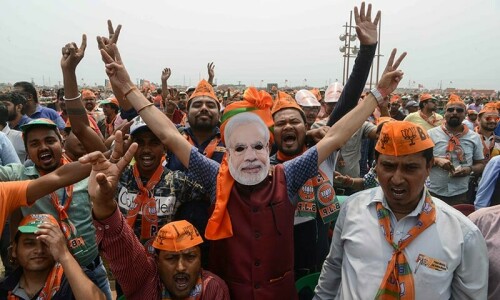
Modi, 73, remains resoundingly popular after a decade in office, and he is widely expected to win a third term when the six-week-long national polls conclude in June.
His prospects have been further bolstered by several criminal investigations into opponents, including a tax probe that in February froze the bank accounts of Congress, India’s largest opposition party.
But Modi said the suggestion India was becoming “an electoral autocracy” under his rule was a fiction spread by his disgruntled rivals.
“Because the opposition is not able to get power, they start defaming India on the world stage,” he told the Times of India newspaper in an interview published on Monday.
“They spread canards about our people, our democracy and our institutions.”
India’s press freedom rankings have declined markedly since Modi took office in 2014, while restrictions on civil society have seen rights groups such as Amnesty International severely curtail their local operations.
This year Modi is being challenged by a motley alliance of more than two dozen political parties, several of whom have leaders either under investigation or in jail facing criminal charges.
Modi’s chief opponent Rahul Gandhi, the son, grandson and great-grandson of past Indian prime ministers, was briefly disqualified from parliament last year after being convicted of criminal libel.
The 53-year-old faces numerous other active criminal cases, several of which were brought by members of Modi’s ruling Bharatiya Janata Party (BJP).
Gandhi and his Congress party already lost two prior landslide elections to Modi, who told the newspaper that his opponent’s unpopularity had no bearing on the robustness of India’s democratic institutions.
“India does not become an electoral autocracy if the ‘Yuvraj’ cannot automatically get power,” Modi said, using the Hindi word for “prince” to disparage Gandhi’s upbringing as a political dynast.
‘Unprecedented display of love’
Turnout in India’s election has so far been several percentage points lower than the last poll in 2019.
Indian media outlets have speculated that higher-than-average temperatures were to blame, with parts of the country remaining subject to a heatwave alert.
Analysts also say voter enthusiasm has been dampened because of the widespread expectations that Modi’s party will easily win the vote.
Modi told the newspaper he remained confident that the BJP and its allies would secure more than 400 seats in India’s 543-seat parliament, its best-ever total.
“Everywhere I have gone, I have seen an unprecedented display of love, affection and support,” he said.