Another petition challenges references against two superior court judges

ISLAMABAD: As a seven-judge Supreme Court bench will commence on Tuesday the hearing of a set of petitions challenging the filing of presidential references against two sitting superior court judges, the Sindh Bar Council (SBC) also instituted a similar petition on Saturday.
Justice Umar Ata Bandial will head the full bench of the Supreme Court which will commence the hearing on Sept 17. The other members of the bench are Justice Maqbool Baqar, Justice Manzoor Ahmed Malik, Justice Sardar Tariq Masood, Justice Faisal Arab, Justice Ijaz-ul-Ahsan and Justice Mazhar Alam Khan Miankhel.
The fresh petition on behalf of the SBC was filed by former chairman of the Senate Raza Rabbani before the principal seat of the Supreme Court in Islamabad, in which President Dr Arif Alvi, the federation of Pakistan through the law secretary and the Supreme Judicial Council (SJC) through its secretary have been made respondents.
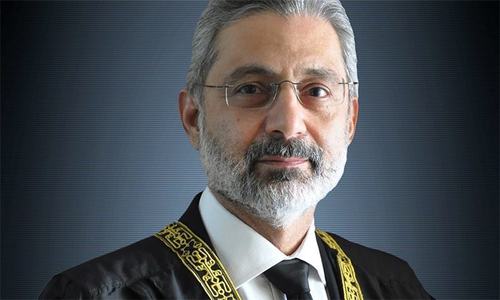
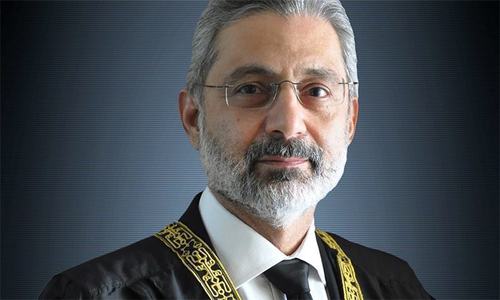
The SJC is already seized with the presidential references against Justice Qazi Faez Isa of the Supreme Court and Justice K.K. Aga of the Sindh High Court.
With the filing of the new petition, the number of challenges before the apex court has risen to seven namely by Justice Qazi Faez Isa himself, the Supreme Court Bar Association, Pakistan Bar Council, a joint petition by eminent jurist Abid Hassan Minto and rights activist I.A. Rehman as well as by Quetta Bar Association president Mohammad Asif Reki.
In its petition, the SBC has argued that patent mala fide intent was floating on the surface in the filing of the presidential references by the federal government, with the intention of placing fetters on the independence of the judiciary, which was in stark violation of the concept of trichotomy of power as envisaged in the constitution.
The petition highlighted that the SJC had showed seeming arbitrariness of priorities in dealing with the complaints/reference against the two judges by the SJC. This has also highlighted the inadequacy in providing procedure for SJC in the Supreme Judicial Council Procedure of Inquiry Rules, 2005.
Soon after filing of the reference, Justice Isa challenged the presidential reference by instituting a petition before the Supreme Court.
On Aug 7, Justice Isa moved the petition by describing the reference against him as if moved by a proxy with mala fide intent to achieve a collateral purpose.
Drafted and filed by Justice Isa himself under Article 184(3) of the constitution, the 71-page petition had sought a declaration that the in-camera hearing of the references by SJC were without lawful authority and in breach of the fundamental rights.
“This petition is not just about a judge but sends a signal to all, that they too will be subjected to the same treatment if they persist in acting independently and decide cases according to the constitution and the law by disregarding vested interest,” Justice Isa had cautioned.
A restraining order against SJC was also sought by the petitioner till the disposal of the present petition since the references undermines the independence of the judiciary.
Not only Justice Isa rebutted the allegations of possessing properties in the United Kingdom by his wife and children, the petition had also attacked the SJC secretary, who happens to be the Registrar of the Supreme Court, as well as questioned why Barrister Mirza Shahzad Akbar, chairman of Assets Recovery Unit (ARU) and Ziaul Mustafa Nasim, legal expert (ARU), were carrying out the functions of the bureaucracy when they were not civil servants.
“To the best of petitioner’s knowledge both these gentlemen are not civil servants; they are also not bound by the rules of confidentiality applicable to the civil servants,” Justice Isa had contended, adding those not in the service of Pakistan cannot be assigned the functions of the executive.
The petition had also sought information about the political affiliation of the two gentlemen, especially with the ruling Pakistan Tehreek-i-Insaf or its coalition partners and wondered whether both acted independently.
Published in Dawn, September 15th, 2019