Thirteen artists, with as many individual expressions, conform to Sherbano Hussain’s simple curatorial brief of looking within to express their inner voices and concerns rather than taking inspiration from the outside world.
The fun is in reading and understanding how these different artists articulate a single principle within the varied fields of their art practices. A mix of senior, mid-career and junior participating artists adds to the assortment in terms of content, technique and isms.
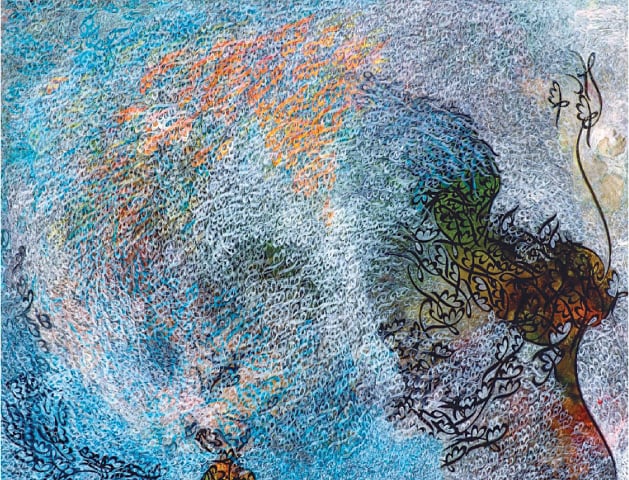
Relying heavily on the assets that printmaking provides, Afshar Malik’s ‘automatism’ — or spontaneous writing, painting and drawing — always pulses to his inner rhythms. The enamel paint on paperwork, ‘Snow Wind And Twister’, carries his characteristic free association of images and words.
The show Inside Out uses the outer manifestation of inner states as its premise
On the other hand, Anwer Saeed’s compositions are complex narratives coded with symbols but decidedly structured and figurative. Vocal about gender sensitivities, Saeed interprets dreams as conduits for unspoken feelings and desires.
The show’s curator, Hussain, also processes her inner reality through dreamscapes but it’s landscapes, simulacra, preconceptions and memories that influence her pictorial montages. Inventive use of mix media, a vibrant palette and images sourcing art history, politics and mass media make her works striking and intelligible.
Two chromogenic prints by Aasim Akhtar, digitally transferred to archival canvas, capture the human body in a state of undressing, and the act of inhaling and exhaling. He employs the skin as an interface for these physical enactments, to create a sense of ‘reveal’ and ‘conceal’ between inside and out.
Another direct illustration of interior and exterior is Ilona Yousuf’s etching titled ‘Chambers Of The Rose.’ She portrays a floral swirl of outer petals emerging from a layered inner cavity.
Ahmed Ali Manganhar has always utilised memories as a primary vehicle of excavating and exploring the past in order to situate himself in the present. His paintings are a meld of his childhood association with billboards, posters and recollections of Pakistani cinema, European art history imagery and his own religious and political beliefs. This context enables easy reading of the inner world whilc he has processed from external stimuli in ‘Theatre Of Memories’ and ‘Cezanne’s Fermenting Apples 2019.’

Far removed in form, medium and technique from Maganhar’s art, Saba Iqbal’s TV and radio art pieces — crafted from Burma teak wood, metal and found objects — also use memory as a portal to revisit the past. Compared to contemporary technology-automated lifestyles, Iqbal’s fond recollections of these objects serve as reminders of the imperfect but simpler and more humane decades of the 1970s and the 1980s to establish her take on Inside Out.
For Amna Hashmi, excitement is not in receiving a gift but in unpacking it. ‘The Deliciousness Of Unpacking’, her Inkjet, gouache and gold leaf prints, relate to her joy of discovering by peeling, unfurling or simply delving in the surprise object. Qadir Jhatial illustrates seated figures, reading. How we assimilate information and knowledge is an inside-out act for him. Anas Ghouri’s and Zoya Currimbhoy’s art is open-ended — it does not reveal any specific readings.
The diversity found in group shows can be overwhelming and generally viewers skim through the exhibits. Artists’ inner states are first and foremost personalisations; such art can be seen instantly but it requires long periods of focused contemplation. It releases its meaning slowly over time. But aesthetically, appealing art can be enjoyed without context as well. Do we, then, need to understand the artist’s personal modes of thought in order to understand a painting? This question is especially relevant in contemporary art, since a large portion is conceptual and relies on context as much as aesthetic impact. Inside Out complies with this reality, too.
“Inside Out” is being displayed at Chawkandi Art in Karachi from August 22 to September 16, 2019
Published in Dawn, EOS, September 15th, 2019