PRIME Minister Imran Khan’s statement in Lahore on Monday must signal the start of a campaign that needs to be conducted on a war footing.
The premier said that Pakistan would not start a military conflict with India — his words providing some much-needed relief to the ears amid weeks of nonstop sabre-rattling rhetoric churned out by commentators of various hues and intensity.
To Mr Khan’s credit, this was not the first time he has spoken of the dangers of imposing a war on the subcontinent.
In his latest remarks about how war was more a problem than a solution, he has only reiterated previously expressed views about the evils that a military conflict between the two nuclear-armed countries could let loose in the region and beyond.
This has been the gist of his diplomatic drive to make the world pay attention to the Kashmir crisis and the tensions it has sparked in the region.
In contrast, the general thrust of pro-war opinion in India, and also in Pakistan, is itself an urgent reminder to the international community of just how easily a group of people can be made to yield to agents that promote violence as a means of deciding a question.
Experts are warning that Pakistan and India have never appeared closer to a war than when they confirmed their respective nuclear capabilities in 1998.
The credit or blame for this impression can be squarely placed on the shoulders of the unabashed promoters of boyish bravado.
Vividly imagined scenarios — of a limited skirmish, of a conventional battle involving fighting on several fronts, and of a full-blown, devastating nuclear climax — have all been paraded before our eyes ever since Prime Minister Narendra Modi embarked on his latest adventure in Kashmir.
The total annihilation of fellow human beings that warmongers build their grandiose delusions of triumph on ought to be enough to leave any reasonable soul wary of violent confrontation.
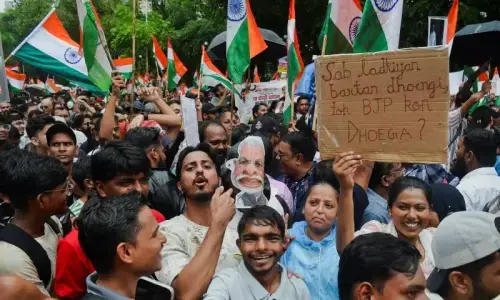
But these tales have been spun with quite a lot of pride, with sections of the media in India as well as in Pakistan skilfully playing the role of agent provocateur, egged on at times by the careless and even reckless remarks of public officials.
There have been attempts to neutralise such vitriol by reminding all of the ugly face of war — but these have, by and large, been drowned out in the din of pro-war rhetoric.
Mr Khan’s statement could go a long way in combating the war hysteria generated in the name of patriotism.
Theoretically at least, all that is now required is a reciprocal message from an unfortunately bellicose India.
It must provide reassurance that the two countries are as capable of avoiding an armed conflict as enthusiastic groups of people in their respective jurisdictions have unfortunately been at beating the drums of war.
Published in Dawn, September 4th, 2019