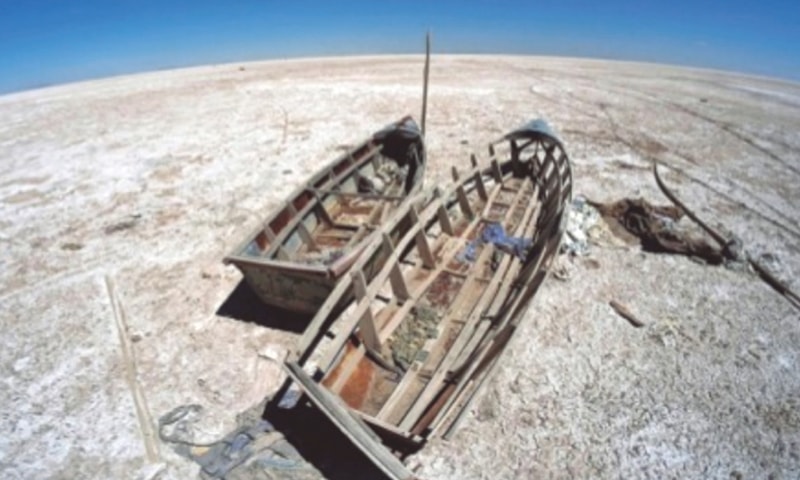
Philosopher and ecologist Garrett Hardin was well-known for proposing a notorious solution to climate change. He imagined a lifeboat with rooms for 60 people. Fifty people are already onboard and more unfortunate people are swimming in the ocean, begging to be saved. Of the available options, he suggested, if those onboard try to save everyone, the boat sinks and everyone drowns, resulting in “complete justice, complete catastrophe.” Hardin used this story to point out that poorer nations double much faster than richer populations. If they are to be saved, everyone including the richer population will become extinct in the coming crisis.
The harsh reality of “climate apartheid” is reflected in this metaphorical story. The people in the lifeboat and those swimming for life are divided by their predetermined position on Earth. While Hardin observes that the poor are to be blamed mostly for taking up more of the population space, Stephen M. Gardiner argues that richer nations are liable for most historical and current emissions. He also believes that poorer nations will be the worst sufferers of climate change caused by these emissions.
These facts make climate ethics a very complicated subject to talk about. It deals with all the things we do not like, or want, to hear. Gardiner believes there are many unresolved issues geographically, inter-generationally and theoretically. Yet, even if there is an answer, we may be morally corrupt because of our inability to act or vice versa. We call this climate denial, Gardiner calls it “a perfect moral storm.”
The harsh reality of “climate apartheid” is reflected in this metaphorical story
A perfect moral storm is essentially moral in nature, because it invokes moral dilemmas where a huge population’s life is in question against the lives of larger groups of people, like Hardin’s lifeboat metaphor. Climate scientists have been warning us about this for a long time, yet only in recent months has the scene escalated. Ireland, France and Canada have declared Climate Emergency as scorching heat ravages Europe and elsewhere around the globe. Irregular flooding is happening more frequently as the polar ice has been visibly melting in recent years. It is scary to know that most of these were predicted long ago and are now becoming our everyday reality.
The latest prediction to make the headlines is from Philip Alston, a UN human rights expert, who believes the climate apartheid may soon become widespread, where the rich would have the ability to pay their way through the escalating heat while the rest of the world suffers. This possibility echoes Hardin’s dilemma.
It is not hard to see where this is going. In 2018, the world’s richest one percent held as much wealth as the world’s poorest 45 percent (Credit Suisse, ‘Global Wealth Databook, 2018’). In case of catastrophic events, the poor lose all their subsistence, and the rich only lose part of their wealth. In that sense, the richer population has much greater obligation towards their poorer counterparts when it comes to climate change.
Yet Hardin’s point may be revisited. Over and over, Hardin has warned us, like many others, that climate change is rushed by exponentially doubling of human population. In nature, there is a rule for this. In a closed ecosystem, when a specific species gets enough food, it increases in number. As a result, food becomes scarce and the population decreases eventually. The food species increase in this phase and again the specific species gets the chance to flourish. This is how one species keeps the other in balance so that none gets extinct. Yet humans have been able to defy this rule, at the cost of many extinct species. Does this mean we will continue to be triumphant?
Prof. Albert Bartlett’s “bacteria in a bottle” analogy is useful to understand why we might end up destroying the whole planet, not just us. In his example, Bartlett explains that a bacterium grows by division — one bacterium becomes two, two becomes four, four divides to become eight, and so on. Imagine putting a bacterium in a bottle at 11.00 am, and its number grows exponentially in this pace per minute. At which point does the bottle get half-full? Bartlett says, 11.59am. This is mathematically identical to the case of exponentially growing human consumption of finite resources on Earth. Bartlett also asks us: if we were the bacterium, when would we realise that we were running out of resources? I hope like the bacteria, it’s not past 11.59 when we realise that we have run out of space, because in the next minute the bottle will be full. And in our case, all the resources will be depleted and the whole population will die without any escape.
All of these pose a very hard challenge for us. If we really valued life on Earth and the survival of the species, we would volunteer to reduce the population. But even this leads to many dilemmas. Who is going to volunteer? If everyone volunteers, who will stay? If no one volunteers, what will happen? These are not just imaginary questions. These are real problems in which we all become prisoners in dilemma, unable to communicate with others, we act selfishly, and thus everyone ends up acting selfishly. The boat ultimately drowns.
In his novel Inferno, Dan Brown sketches an antagonist who creates a vector virus that randomly targets a population with infertility syndromes. The purpose was to save the Earth. While this may be too dramatic for reality, there must be some other ways to reduce population through consensus — through the awareness of the impacts we make by making simple decisions.
The climate crisis is expected to become more intense in the coming days. If we think we will sit and wait for the others to take care of everything, may be those who are next to us are thinking the same thing. A sinking boat does not simply sink from a hole; it sinks also from the collective denial and avoidance of due duties by its boatmen.
By arrangement with The Statesman
Published in Dawn, EOS, August 4th, 2019