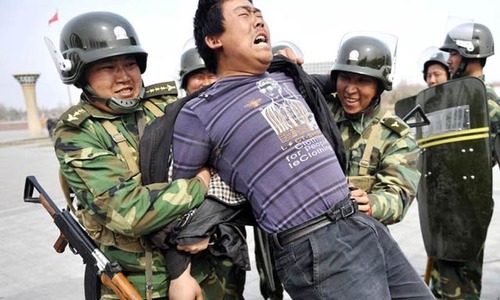
Beijing says ‘most’ inmates in Xinjiang have left their camps

BEIJING: Chinese officials on Tuesday said “most” individuals held in re-education camps in its northwest Xinjiang region have left the centres and found jobs — though they did not provide any figures.
In Xinjiang, experts and human rights groups say more than one million Uighurs and other mostly Muslim minorities are held in a network of camps where they endure political indoctrination.
But Alken Tuniaz, vice chairman of Xinjiang, told reporters at a press briefing that “most personnel who have received educational training have already returned to society and have returned home.” “Right now, most have already completed their studies and obtained employment,” he said.
After initially denying their existence, Beijing has gone on a public relations blitz to defend what it calls “vocational education centres” as a necessary measure to counter religious extremism and boost employment.
At a press conference in Beijing, officials from Xinjiang called the centres “effective.” “After these past one to two years of effort, most of the people at the training centres who return to society — you could say more than 90 percent — have found work that they like and find suitable,” Shohrat Zakir, chairman of Xinjiang, told reporters.
He also said the centres aim to teach inmates three topics: Chinese law, Mandarin, and “the true meaning of religion.” “We let them know... how to carry out normal religious activities, under the protection of the law,” he said.
But former inmates have said following Islamic traditions, such as wearing long beards and face veils, was the reason they were incarcerated in the first place.
A Kazakh businessman, who spent nearly two months in a camp, said the facilities only had one goal: to strip detainees of their religious belief.
Inmates were forced to sing patriotic songs every morning and eat pork, a violation of Islam’s religious restrictions, he said.
Re-education camp detainees have also reportedly been used as forced labour at Chinese factories.
In December, an article in The New York Times showed that a United States sportswear company had received a container of T-shirts from Hetian Taida, a company in Xinjiang shown on state television to have been using workers from re-education camps holding Muslim minorities.
Badger Sportswear has since said it would stop sourcing clothing from Hetian Taida in Xinjiang.
“Uighurs are being marginalised, and their culture and identity is being eliminated,” said Dilxat Raxit, spokesman at the exiled World Uyghur Congress, in a statement.
“Taking measures to force people to give up their faith is a strategic policy that the Chinese government is carrying out locally,” he added.
Chinese officials spent most of the press briefing praising the economic successes of Xinjiang over the past 70 years, including increases in gross domestic product, disposable income, and improved infrastructure.
However, these improvements have required an enormous amount of financial support from the central government.
From 2012 to 2018, Beijing provided 1.61 trillion yuan ($23 billion) in subsidies to the Xinjiang government, said Zakir.
Published in Dawn, July 31st, 2019