Political clouts reign supreme over crude

‘Crude’ front is heating up. Events are beginning to happen, and, in quick succession. Ominous clouds could be seen hovering all around.
Amid, escalating UK-Iran tensions, the UK is deploying a second warship in the Persian Gulf, where reportedly, three Iranian boats had attempted last Thursday to “impede the passage” of a British oil tanker, forcing the UK warship HMS Montrose to intervene. However, Iran’s Revolutionary Guards denied the incident. “There has been no confrontation in the last 24 hours with any foreign vessels, including British ones”.
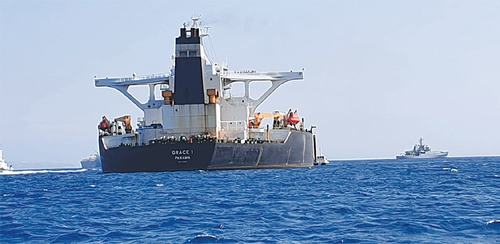
This happened in the backdrop of reports that the British Royal Marines had seized an Iranian crude supertanker off the coast of Gibraltar, carrying oil to Syria, in contravention of the ‘EU sanctions’ against Bashar Al-Assad.
The Government of Gibraltar later confirmed that the Iranian supertanker was laden with 2 million barrels of crude oil. Iran however, insisted the tanker was in international waters, not headed to Syria, and the seizure was done at the behest of the United States.
Iranian Foreign Ministry spokesman in a tweet said, that the British Ambassador Rob Macaire was summoned over the “illegal interception”. Tehran also vowed to retaliate. “It will be reciprocated, at a suitable time and in a suitable place,” Mohammad Bagheri, the chief of staff for Iran’s armed forces warned.
In a precautionary move, BP Plc was reportedly keeping an oil carrier empty inside the Persian Gulf, close to Saudi Arabia, rather than risk its seizure by Iran.
In the meantime, the London based Al-Araby Al-Jadeed reported that the Egyptian authorities have also detained a Ukrainian tanker carrying Iranian crude, as it was passing through the Suez Canal. News of the seizure came a day after Egypt’s Supreme State Security Criminal Court sentenced six people to jail on charges of spying for Iran.
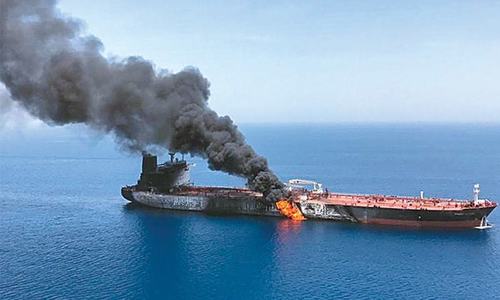
Since early May, six oil tankers have been attacked, near the strategically important Straits of Hormuz. The U.S. and its allies blamed Iran for the incidents, a charge that Tehran denies. The temperature gauge is beginning to turn red.
Consequent to all this, tankers are shunning the port of Fujairah in the UAE, the main refuelling hub of the Middle East, Bloomberg quoted traders as saying.
Tanker owners were worried about the situation and were opting to refuel elsewhere. Insurance premiums are going up. The port of Fujairah, Matt Stanley from Dubai-based Star Fuels told Bloomberg, is experiencing “a significant drop in demand owing to war-risk premiums”. Insurers were quick to raise premiums after the tanker attacks. Between the end of May and the middle of June, tanker insurance premiums jumped by between 5 and 15 percent, Oilprice reported.
In another related development, late in June, Iran shot down a US drone, allegedly launched from the UAE territory, claiming it was violating the Iranian airspace. This made the temperature only rise. President Trump opted out of the retaliatory strikes, literally minutes before they were to take place.
On the other hand, while the US continues to insist on its maximum pressure campaign, Iran has so far managed to keep its oil exports from collapsing to zero. The Iranian Oil Minister Bijan Zanganeh is hopeful of improvement in its crude exports. “I am very hopeful that our oil exports will improve,” Zanganeh told the Iranian state TV.
Battling what he called “the most severe organised sanctions in history,” Zanganeh last week vowed to keep selling oil via “unconventional means”. As the New York Times reported, some oil tankers have recently resorted to switching off their transponders as they enter the Persian Gulf, likely loading up with Iranian oil and then heading out towards markets in Asia.
Despite Washington’s ‘zero tolerance policy’, China and Turkey appear to be the most obvious destinations for the Iranian crude. The Islamic Republic state TV recently aired a programme showing an Iranian-flagged tanker, delivering one million barrels of crude oil to China, despite the sanctions.
Kpler, a firm that tracks the movement of oil tankers, told media that Iran exported 186,000 barrels per day of oil to China in June. It said the oil tanker Salina delivered 1.05 barrels of oil to China and another Iranian tanker, The Horse, 2.13m barrels of crude to Chinese ports. Turkey in the meantime, has also received 1.03m barrel shipment from Iran, the report added.
Interestingly, power politics continue to rule the world while the hawks in Washington appear least bothered. And as a battle of ‘crude’ wits is on, disastrous and unintended consequences remain very much a possibility.
Published in Dawn, July 14th, 2019