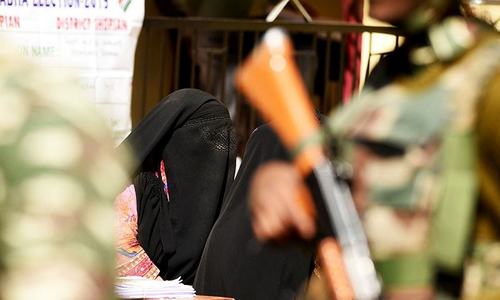
Media feel the pinch in Indian-occupied Kashmir

When plainclothes police arrested newspaper editor Ghulam Jeelani Qadri, his peers in Indian-occupied Kashmir saw it as just another attempt by New Delhi to squeeze the media working in the blood-soaked region.
Prime Minister Narendra Modi, in power since 2014, has tightened the screws on the part of Kashmir occupied by India, particularly since February when a suicide bombing killed 41 Indian troops travelling in a convoy.
The attack, claimed by banned militant group Jaish-e-Mohammad (JeM), prompted tit-for-tat air strikes between the two nuclear-armed nations over a region divided between the countries since 1947.
In step with beefed-up security, New Delhi has pressured the media inside occupied Kashmir by intimidating reporters with legal threats and putting restrictions on movement as well as pulling ad revenues from troublesome outlets, journalists say.
Qadri, publisher and editor of Urdu-language daily Afaaq, told AFP that he was given no reason for his arrest by the plainclothes police who took him from his Srinagar home on June 25. “They simply asked me to accompany them."
His arrest was linked to a case from 1993 when he published a statement from an anti-India militant.
Although he was freed a day later, the revival of the three-decade-old case was quickly interpreted by the media community as a warning.
There is “an invisible sword hanging over your head”, one editor in occupied Kashmir told AFP of the threat of legal cases, speaking anonymously for fear of reprisal. Other local reporters have also been arrested.
Asif Sultan, has been in jail since August 2018 over a report about a rebel leader, charged with having contact with and promoting militants.
'No investigation possible'
Some 70,000 people, mostly civilians, have died over the past 30 years in Indian-occupied Kashmir, monitoring groups say.
The clash is between Indian soldiers — who number around 500,000 on the ground — and Kashmiri fighters wanting either independence or union with Pakistan.
Clashes between security forces and Kashmiri fighters — which often escalate as demonstrators gather — have been a near-daily occurrence since India launched “Operation All Out” after the death of charismatic militant Burhan Wani on July 8 in 2016.
Read: India imposes curfew across occupied Kashmir on Burhan Wani's 3rd martyrdom anniversary
Since the February bombing, the deadliest attack on Indian forces in three decades of insurgency, India has arrested 900 people.
Accusations of human rights abuses, arbitrary detentions have followed, as anxiety and anger mounts in the Muslim-majority region. Moves by Modi's government to scrap laws that bar Indians from elsewhere buying land in occupied Kashmir have also irked locals.
Covering violent protests, which frequently see Indian forces use lead-pellet-firing shotguns on protestors, has become even harder.
“We're stopped miles away. No investigation by journalists is possible,” said Umer Arif, a freelance journalist. “So, we show what the government forces want us to show, not much else.”
Foreign journalists also need special permission to visit the territory.
Indian-occupied Kashmir was brought under New Delhi's direct rule in June 2018 after Modi's Bharatiya Janata Party (BJP) withdrew support for its local partner and dissolved the elected local government.
Tens of thousands of extra troops were brought in for a general election in May that saw the right-wing Modi re-elected. During the voting, the main highway linking Kashmir with India was closed to civilian traffic two days per week for two months.
'Humiliation and pain'
The Indian government has also stopped issuing advertisements to Kashmir Reader and Greater Kashmir, the biggest English-language daily, effectively “choking” it, according to its editor-in-chief Fayaz Ahmad Kaloo. That has left little money for reporting or investigations.
The Committee to Protect Journalists (CPJ) says the freeze on advert spending is one of a battery of moves by the Indian government “to silence criticism of its policies in Kashmir”.
“They want independent voices to go to oblivion,” added Anuradha Bhasin, editor of Kashmir's oldest English-language newspaper the Kashmir Times.
Manoj Kumar Dwivedi from the Indian Administrative Service who oversees the government information department conceded that advertising had been withdrawn to selected titles but insisted newspapers could publish what they liked.
“It has nothing to do with public interest,” Dwivedi told AFP. “If any individual newspaper has a grievance they should approach the relevant authorities. “