Judge visits Larkana jail, orders HIV test of inmates


 1
1

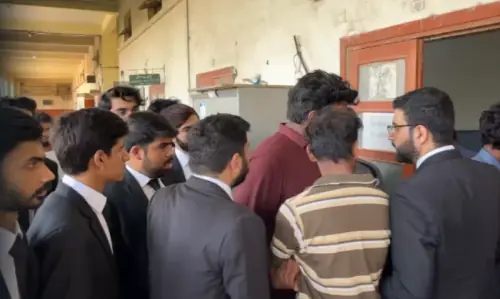
LARKANA: During his visit to the central prison here on Friday, District and Sessions Judge Abdul Naeem Memon ordered the jail authorities to immediately make arrangements for the blood screening of prisoners for HIV/AIDS.
He also asked the medical officer (MO) concerned about conducting HIV/AIDS tests of the prisoners.
The doctor told the sessions judge that the medical superintendent of Chandka Medical College Hospital (CMCH) and the district health officer (DHO) of Larkana were approached and requested for supplying kits to carry out the required blood tests. But the jail did not receive the required kits, he said.
This information irked the judge and he summoned the DHO on Saturday to the court.
One dies as HIV cases rise to 733
As many as five new HIV positive cases emerged out of the 225 screened at the camp in Ratodero on Friday which increased the total HIV positive cases to 733, PPI adds.
Out of these 733 cases, 598 are children and 135 adults and so far 25,433 people out of general population have been tested in Ratodero since April 25, 2019. However, no case was detected at the screening camps of Banguldero and Naudero where 125 people were screened.
A five-year-old boy died of AIDS in the village of Ghulam Hussain Hakro.
Meanwhile, the WHO team headed by Oliver Morgan visited the Taluka Headquarter Hospital (THQ) in Ratodero, met the technicians working at the blood screening camps and inquired about the test methods.
They were astonished at the manual way of the blood screening.
The team also visited ART Centre in Larkana where they also expressed their anger and dissatisfaction as there was no waiting room for the affected patients and entry data was not being made properly.
They asked as to why children were sent to the civil hospital for tests which is far away from the centre.
They also asked as to why patients of Ratodero were coming to Larkana for getting medicines; why so far CD-4 machine had not been provided at Ratodero. They said patients should be given all required facilities under one roof.
On the other hand, this reporter has learnt that experts have been warning that Larkana has all the ingredients of an exploding HIV epidemic in the future.
The Journal of Pakistan Medical Association (JPMA) has been publishing multiple articles over the years, chronicling the spread of AIDS/HIV in Pakistan. Experts had been sounding alarm bells as early as 2014.
It had been written that Larkana, a small town of over half a million population, has surpassed Karachi, a metropolis of almost 20 million persons, in risky practice. The first major outbreak of HIV in Pakistan occurred in 2003 among persons who injected drugs in Larkana.
At that time, a survey revealed that 17 out of 175 such people were confirmed HIV positive.
The population welfare department estimates that in 2010 the total population of the district was around 1.4 million and that of Larkana city 539,075.
Larkana came into the HIV limelight in June 2003 when the first outbreak of HIV among people receiving medicines through injections was reported in which 17 out of the 175 were confirmed positive.
By 2016, another outbreak was reported in Larkana. This time 56 dialysis patients were among the patients in Chandka Medical College Hospital’s dialysis centre.
The National AIDS Control Programme did its own investigation. Dialysis patients were screened using the HIV rapid test kits (ImuMedOne Step Diagnostic Test).
Injection drug users (IDUs) and commercial sex workers are the high-risk groups.
The Sindh AIDS Control Programme (SACP) started working on prevention and control of HIV infection in Karachi, Hyderabad and Sukkur in 2006. The clientele of sex workers were unmarried or married men, migrant workers and long-distance truck drivers living away from home.
Published in Dawn, June 1st, 2019