Dr Shireen Mazari cautions against US push to make India member of NSG



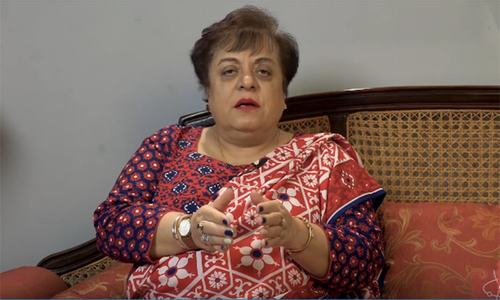
ISLAMABAD: Minister for Human Rights Dr Shireen Mazari on Thursday cautioned against the US push to make India a member of the Nuclear Suppliers Group (NSG).
“India’s membership would put Pakistan at a severe disadvantage. India’s rapid modernisation of its nuclear forces is adversely affecting the strategic stability in the region,” she said speaking at a workshop, “The international strategic environment and Pakistan’s policy imperatives” organised for women parliamentarians.
The minister gave an overview of the non-proliferation and arms control regimes while drawing attention to Pakistan’s nuclear policy.
Says India’s membership of Nuclear Suppliers Group will put Pakistan at severe disadvantage
In the non-proliferation regime, she spoke about two approaches: a US-centric discriminatory approach and a universal non-discriminatory approach.
She said Article 6 of the Non-Proliferation Treaty (NPT) was inherently discriminatory which called on the five recognised member states to act “in good faith” towards nuclear disarmament.
However, the article remained non-binding, she said, adding the NPT did not focus on vertical proliferation while stressing horizontal non-proliferation.
Dr Mazari highlighted Pakistan’s position on the Fissile Material Cut-off Treaty (FMCT) that is currently being negotiated at the Conference on Disarmament. She stressed Pakistan’s position to have member states reduce their existing stockpiles of fissile material before capping its future production.
“Without reduction of existing stockpiles of fissile materials, suspending its future production would leave Pakistan at a disadvantageous position relative to India’s larger nuclear stockpiles,” she asserted.
Discussing the non-proliferation issues, she criticised the trend post-9/11 in which international focus was shifted from non-proliferation of nuclear weapons to nuclear programmes of certain countries such as Iran and Pakistan.
Discussing India’s nuclear posture, she said India was enhancing its nuclear triad — its capability of launching nuclear weapons from land, air and sea. She said India had also retreated from its commitment on the No First Use Policy in 2004, claiming that it reserved the right to use nuclear weapons. Discussing Pakistan’s nuclear doctrine and how it rested on maintaining a credible minimum deterrence, she argued that India’s Cold Start Doctrine, a strategy to engage Pakistan into a limited conflict, was effectively countered by Pakistan’s successful development of its short-range ballistic missile, Nasr, which was able to plug the gap at the tactical level of war.
In response to India’s BMD system, Pakistan has test-fired Babur-III submarine, launched cruise missile (SLCM) and Ababeel surface to surface ballistic missile capable of delivering multiple warheads using Multiple Independently-targetable Re-entry Vehicle (MIRV) technology.
The Babur-III SLCM provided Pakistan a credible second-strike capability, according to the minister.
In order to avoid an arms race in South Asian, Dr Mazari said Pakistan had earlier proposed several suggestions to India, including a moratorium on nuclear testing, which India refused. Pakistan also suggested India established a strategic restraint regime in the region which the country again did not accept.
Highlighting Pakistan’s role in arms control and disarmament, she said prior to 1998 Pakistan had repeatedly introduced a resolution at the UN regarding a nuclear-weapons free zone in South Asia.
“Pakistan had also offered India to renounce the development of nuclear weapons in the region but no initiatives were taken on these proposals. Pakistan signed the international convention on nuclear safety in 1997 as a part of the country’s commitment towards the non-proliferation regime,” she said.
After the nuclear tests in 1998, Pakistan Nuclear Regulatory Authority was created as a competent and independent body for the regulation of nuclear safety, radiation protection, transport and waste safety, she said.
Published in Dawn, April 26th, 2019