0
0

KARACHI, July 10: The long neglected Sindh Forensic Science Laboratory (SFSL), despite its poor state of affairs, has sent a record of 27,000 finger prints of offenders to the Automated Finger Print Index System (AFIS) being developed by federal agencies.
The work has been done by the Finger Prints Unit of the SFSL over the past two years. The unit’s primary responsibility is to collect finger prints from a scene of crime, although it would respond to a crime scene only when called out by police, according to DSP Taj Mohammad Almani who is currently holding the charge of the finger prints department. The laboratory is supposed to accomplish the assigned work covering the entire province.
The lab is not a matter of priority for the Sindh government and, ironically, some officials of the Home Department are even unaware of its existence.
The poor state of affairs at the laboratory can be gauged from the fact that the finger print department does not have a single piece of typewriter, nor does it have typing or writing paper. Allocation or release of funds is a far cry.
Experts at the age-old laboratory obtain finger print impressions using paper, a conventional method, which is stated to be 62 per cent successful. However, use of scanner fro the purpose would surely yield 100 per cent results.
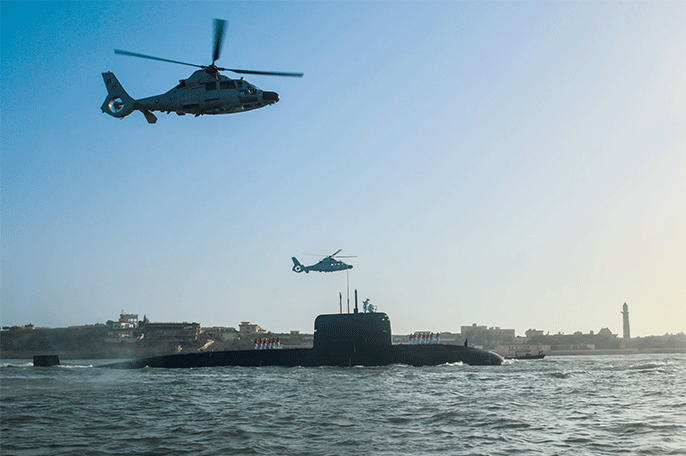
Despite no essential facilities made available to the lab, the officials concerned registered remarkable success in solving mysteries and helping in some high profile cases. In this regard, the officials give numerous examples, including the one where they established identities of the Navy personnel who died in a plane (Atlantic) crash. The plane was shot down by Indian forces in the Run of Kutch in 1999. The bodies were badly charred and unidentifiable.
“We established identities of the servicemen by matching their thumb impressions with the specimen in their passports, besides the samples of their skins, said DSP Almani.
Similarly, the lab’s finger print experts had been called out to the scene of the attack on Karachi corps commander to collect the finger prints of suspects from the vehicle they had abandoned at the scene after the attack, he added. Moreover, the finger print unit had provided valuable evidence in the Asma Nawab case, Afghan Carpet case, etc.
Assistance of the finger prints department is also sought in civil cases, officials at the finger prints department said, adding that since 1998, some 35-40 cases had been solved with its assistance. The present staff claimed that between 1985 and 1998, things had turned bad due internal politics in the lab. “Even the ACR’s were not being signed during that period,” the officials requesting anonymity stated. The things had been put in order only after the SFSL charge was given to DIG Javed Iqbal, they said.
The premises of the SFSL, on Garden Road, looks like a museum, rather than a science lab, a visit shows, as the lab has a pile of obsolete equipment dating back to early ‘60s and ‘70s. “When suppliers these articles were asked to teach our staff how to operate them, they simply regretted, maintaining that the manufacturers of these equipment have now stopped producing the same and the relevant manuals that could help in this regard were no more available, “ DSP Almani told Dawn.
There is hardly any one of the equipment that has been put to use since its arrival. In 1985, three mobile forensic units were imported from the United States. At soon as they landed at the port, the built-in video system was stolen from one of the units.
At present, the SFSL has only one mobile unit that is lying at the ground floor of the lab whereas the whereabouts of the other two are not known.