IN a more developed democracy, the arrest of a minister for an official investigation into corruption allegations would have been a routine occurrence worthy of routine curiosity.
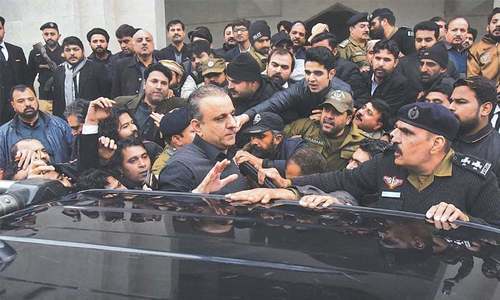
In Pakistan, the detention of senior provincial minister Aleem Khan is an issue which may help define the quality and capacity of our democratic order.
Do we finally have it in us to put under scrutiny those in power? Can we ask them to explain their doings? Can we, now at this stage of our difficult journey towards the rule of law, resist diversionary tactics and streams of thought to concentrate on the purely legal aspects of the case under discussion?
Mr Khan has been in the news for his rapid rise in business. While this in itself is no crime, his visit to the NAB offices had long been on the cards.
The allegations against him are serious and even in a system more biased in his favour, there would have been a few interrogations. Now that he has reached this critical point and a moment of reckoning the less the government politicises the issue, the greater it will be to the credit of the PTI dispensation.
There is talk of how the arrest of Mr Aleem Khan, which was followed by his resignation from the post of senior minister in Punjab, is some kind of a prelude and justification for action against an opposition bigwig.
Read more: Shahbaz Sharif no show at accountability hearing, to be indicted in Ashiyana case on Feb 18
This is just too basic and too transparent a scheme for even the simplest administration to attempt, and the PTI and its advisers are experienced enough to understand this.
The opposition as well as the media busily angling for any clues to discrimination may, consequently, want to ensure as best as they can that the suspect is investigated as thoroughly as would be any other Pakistani in his situation.
This is why it is as much a trial of NAB as it is of its latest celebrity guest.
The accountability bureau has to be mindful of the fact that the public’s eyes are fixed on its workings and will be looking for any signs of slackness in the performance of the bureau or of the latter’s prejudice against the individual who is under probe.
There is an example being created here. In the interest of a quality system, let us try and make sure that the model is based on the principles of fairness and justice.
Published in Dawn, February 8th, 2019