SC lambasts 'insensitive' government for failure on water conservation, taxation


 6
6


The Supreme Court on Monday expressed disappointment with the central and provincial governments over their failure to devise a mechanism for the conservation and purification of underground water and impose tax on its extraction, in line with a previous decision of the apex court.
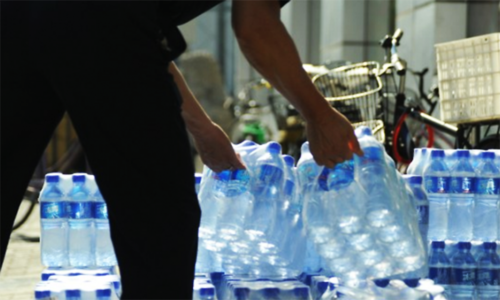
A three-member bench, headed by Chief Justice Mian Saqib Nasir, was hearing a case pertaining to conservation, purification and taxation on extraction of underground water by bottled water companies.
Last week, the apex court had imposed a levy on companies selling mineral water and beverages at a rate of Re1 for every litre of surface water extracted by them. The revenue so collected will go to the Diamer-Bhasha and Mohmand dams fund. Authored by Chief Justice Mian Saqib Nisar, the judgement also required the provincial governments as well as the Islamabad Capital Territory administration to set up separate and distinct accounts to receive the amounts collected under the water charges. The amounts will then be deposited in the SC-created dams fund.
The judgement was issued on a suo motu case pertaining to selling by the companies of water extracted from underground sources without any charge as well as the quality and fitness of the same for human consumption.
The apex court had also constituted a special committee to devise a mechanism for calculation, collection and monitoring of the recovery of water charges from all major industries consuming surface or groundwater. The court had directed the federal and provincial governments to ensure installation of a foolproof and state-of-the-art metering mechanism at every extraction unit. The extraction will be monitored closely by the respective EPA on a daily basis, the verdict said.
On Monday, the chief justice remarked that water has become more "precious than gold [but] if we passed remarks [over the situation] then headlines would state that [the judiciary] has raised questions on the credibility of the government".
Dr Abdul Rahim, the secretary of the Law and Justice Commission — established for the systematic development and reform of laws — informed the top judge that neither its recommendations on the issue were heeded upon, nor an awareness campaign was launched.
The representative of the Punjab government, Owais Ahmed, informed the bench that the provincial government had approved 31 recommendations out of 38. He said that the government has formed a task force on water reservoirs, purification and taxation to deal with the issue.
Chief Justice Nisar reprimanded the representative, saying that the Supreme Court-mandated Water Commission did a lot of work, "the government[s] are provided with everything but they don't want to do anything."
"The Punjab government lacks both the will and the capability," the chief justice remarked.
"It seems that you people have decided to kill people of thirst [while] bureaucratic tapes appear in each and every matter. It seems that all the papers will be left in the record room of the court."
"[We have] said time and again to take measures on a war-footing basis [to resolve the issue]," he added.
The law and justice commission secretary pleaded the court to issue an order in this regard, to which Justice Nisar replied: "The court will continue to issue orders but the government has become insensitive. People's lives are associated with water. If the government does nothing, it will be criminal negligence."
Justice Ijazul Ahsan remarked that the price of water being used by sectors other than bottled water should also be fixed.
The bench observed that the Punjab government had devised a good plan as per the apex court's directions but only on paper. "No political will is seen," Justice Ahsan remarked.
The apex court declared that the reply submitted by the Punjab government was an attempt to eyewash the judiciary and ordered the federal and provincial governments to submit a fresh response within 15 days.
Meanwhile, the commission's secretary said that the ICT administration also lacks a mechanism. He informed the court that the Capital Development Authority (CDA) charges a Rs100 water fee from each and every household, no matter how big or small it is.
The top judge expressed his displeasure over the situation and reprimanded the authority.
During an earlier hearing, the apex court had noted that the government of Sindh had set prices for the use of groundwater. "Balochistan too has set prices for mineral water and soft drinks," a representative from the Balochistan government had informed the court.