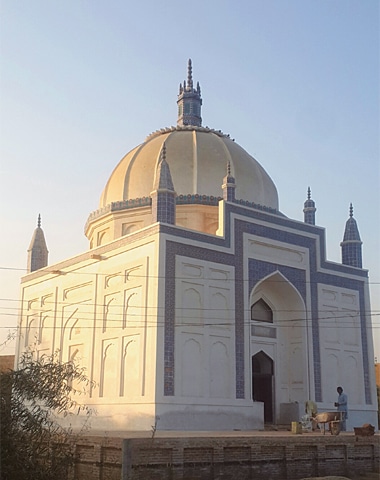
LARKANA: The Endowment Fund Trust for Preservation of the Heritage of Sindh (EFT) on Sunday handed over possession of the 18th century Shah Baharo tomb — after having completed work on its restoration and rehabilitation — to Sindh culture department.
Ishtiaq Ansari, regional coordinator of EFT, presented keys of the tomb to Ehsan Abbasi, curator of Moenjodaro in a simple ceremony held at the tomb near Arzi Bhutto village on the outskirts of the city. Leading poet and TV playwright Ayoub Gaad chaired the programme.
Shah Baharo, whose forefathers belonged to what is today’s southern part of Punjab, was a gallant general in Kalhora rulers’ army who remained invincible on the battlefield till his death.
Work executed in four years at a cost of Rs8.7 million
Born in Bubak village (Dadu) on Nov 21, 1665, he fought his first battle against Daudpota tribe at the age of 58 and later defeated Abdullah Khan, leader of Brohi tribe in a battle in Ganjaba near Khanpur (Kaccho). He also led his army against Queen of Kaache Kaanjhi (now Badin) in 1746, according to EFT handout distributed among participants in the programme.
Loyalty to Kalhora rulers ran in the family of Shah Baharo as his father Ghulam Haider, who had later settled in Qambar, was also a faithful aide to Shahul Mohammad Kalhoro. Shah Baharo’s brother Maqsoodo Faqir was also a devoted soldier of Kalhora rulers, Mian Naseer Mohammad and Mian Din Mohammad.
Shah Baharo, who was well versed in Sindhi, Arabic and Persian and was also a hakim, had won all the 84 battles he led and fought till his death during the reign of Mian Yar Mohammad Kalhoro (1700-1708) and remained grand minister of Mian Noor Mohammad Kalhoro with 10,000 soldiers under his command.
Mian Noor Mohammad had built Kaachoo Qilo (mud brick fort) for his illustrious commander, which had four watchtowers with cannons perched on them. The fort could house Shah Baharo’s 10,000 soldiers who were mainly Jatoi and Khoso tribesmen.
Mr Ansari said the work on the tomb was completed at a cost of Rs8.7 million, which were provided by the culture department, and spoke at length on the technicalities, hindrances and other issues that EFT had confronted during the repairs and rehabilitation of the tomb.
He said that experts from Lahore were called in to study the pros and cons of the delicate job and authentic books on history and archaeology were consulted to match minute details of the structure that had developed cracks. It took the EFT four years to complete this project, he said, adding that within the tomb alone, 35 kinds of tiles were used.
Currently, he said, the EFT was busy working on the restoration of 40 such projects, including Odho Mari, High School in Shikarpur, Abhagan-Sabhagan’s tomb, Khoso Mari, Rani Kot etc.
Ayoub Gaad urged people to own archeological and historical sites in the province to help save sources of history and called on teachers to arrange frequent tours of students to such places to keep them abreast of their rich past.
He appreciated the efforts of Meeral Abro who had worked devotedly at the tomb and the sincere input by a social worker, Jameel Gaad, who had in real sense sensitised people and departments concerned to the importance of preserving the tomb.
Jameel Gaad had boycotted the event’s proceedings in protest against being ignored. Mr Ansari, however, praised his efforts and expressed regret for the oversight.
Later, he, Ayoub Gaad and others unveiled the plaque.
Published in Dawn, January 7th, 2019