0
0
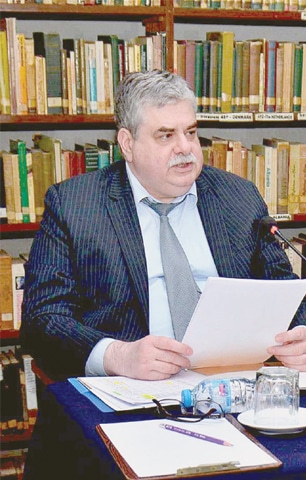
KARACHI: Keeping his promise to return that he made during his first visit to the Pakistan Institute of International Affairs in 2015, Ambassador of the Russian Federation in Pakistan Alexey Dedov arrived at the PIIA on Friday evening to a very warm welcome.
Since the ambassador’s last visit, the moderator of the event said there had been a great change in the global scene and “we look with interest at Russia’s role in world affairs, especially in Syria, and other global issues”.
Discussing Russia’s “stabilising role” in South Asia, Mr Dedov, who has also served in India, Bangladesh and Iran, said that the modern world was undergoing a profound transformation.
Russia has cut down its nuclear capacity by 85pc over the past 30 years, says Moscow’s envoy
He added that they were also witnessing dynamic changes in international relations.
“Globalisation and technological progress contribute to the increased independence of nations,” he said.
Talking about nuclear weapons, Ambassador Dedov said that the Russia Federation stood at the forefront of preventing the spread of nuclear weapons. “Russia has made unprecedented contribution to the progress of this by cutting down its nuclear capacity by 85 per cent over the last 30 years,” he said.
Another important issue, according to Mr Dedov, is the prevention of the arms race in outer space and thus excluding outer space from becoming a new arena and another battleground for military confrontation.
“Thus Russia, China and Pakistan along with many others are promoting this and are in negotiation to stop weapons from going into outer space,” he said, adding that Russia was also working with Pakistan to counter terrorism.
Emphasising relations with other countries, Mr Dedov discussed the Shanghai Cooperation Organisation, which is also called Shanghai Pact, a political, economic and security alliance led by China, Kazakhstan, Kyrgyzstan, Russia, Tajikistan, Uzbekistan, India and Pakistan.
Talking to a packed auditorium with academics, students, foreign policy experts, Mr Dedov said: “The international community needs to respond to global challenges and threats in a comprehensive manner and with combined efforts under the coordination of the United Nations.
“Russia is one of the largest global economies and one of the leading countries in science and technology, a permanent member of the UNSC and part of other groups such as SCO, Asean, which work towards a more sustainable world order,” he added.
He also discussed the problems of international terrorism, the drug trade and organised crime.
The ambassador proceeded to make a joke about how he thought he would not have expected to hear about pirates and piracy in this day and in this age but they were very much there; “one hadn’t heard of them in centuries and now they have been revived”.
Published in Dawn, December 15th, 2018