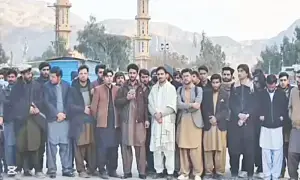
ONCE again, militants in Afghanistan have shown that nothing is sacred to them. Over 50 people were killed as a bomber struck a wedding hall in Kabul on Tuesday where people had gathered to celebrate the birthday of the Holy Prophet (PBUH). At this point it is unclear who is responsible for this atrocity. However, while the Afghan Taliban have distanced themselves from the attack, suspicions have fallen on the local affiliate of the militant Islamic State group, which has been involved in a number of attacks in Afghanistan, aside from the violence perpetrated by the Taliban. IS is particularly known for targeting Muslims it sees as ‘deviants’; its past attacks have had sectarian overtones, and have included violence against the Shia community in the country. While the Afghan Taliban are of course no stranger to violence, IS is a far more vicious and expansionist set-up, comparatively speaking, and has demonstrated its blood-soaked capability in the Middle East. Afghanistan is already a witness to massive levels of violence; as per one figure, nearly 3,000 people have been killed in militant attacks over the past two years. While that unfortunate country has not seen stability for the last four decades, the IS threat cannot be underestimated as its propensity for violence and destruction is arguably greater than that of other militant actors.
The bombing comes as a sobering reminder that all principal actors — the government in Kabul, the Afghan Taliban, external players — must step up their efforts to bring about a negotiated conclusion to end hostilities in the country. While considerable gaps may exist between Kabul and the Taliban, these need to be bridged as IS is a common enemy. Moreover, if the self-styled caliphate were to establish itself in Afghanistan’s ungoverned spaces, the security of neighbouring states, including Pakistan, would be increasingly compromised. Therefore, all players need to facilitate dialogue between Kabul and the Taliban, with the Americans, who maintain a military presence in Afghanistan, as well as regional states playing their role. The world has witnessed the mayhem IS caused when it occupied ungoverned spaces in Iraq and Syria. Now that it has been eliminated from most of its Middle Eastern strongholds, it is looking for a new foothold from where it can unleash turmoil and bring its apocalyptic dreams to fruition. No country must be allowed to become that foothold. The US, with its military muscle and technology, must particularly do more to flush out IS from its Afghan redoubts.
Published in Dawn, November 23rd, 2018