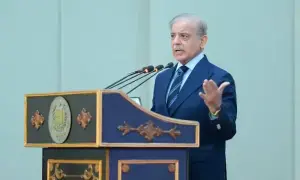
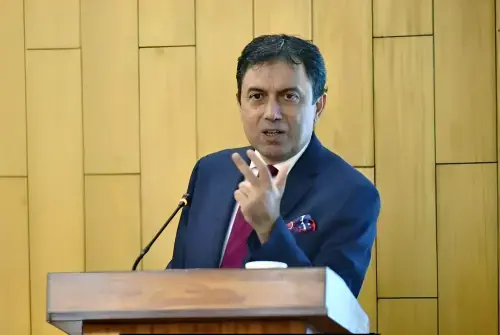
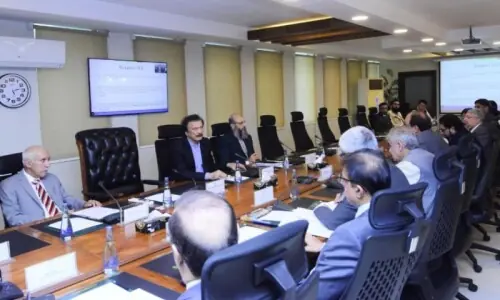
THE PTI government’s intentions with regard to the media are rightly fuelling a growing sense of unease. At a Senate standing committee meeting on Thursday, Information Minister Fawad Chaudhry announced the draft of the recently proposed Pakistan Media Regulatory Authority under which the existing regulatory bodies are to be consolidated to oversee print, electronic and social media. Adding that all the relevant legislation and rules would be merged in order to achieve a one-window operation, the minister said that “no one will be able to defame anyone under the new law”. The statement should raise a red flag, for the prevention of defamation is often a pretext for introducing curbs on the media. Strengthening existing libel laws is a far better approach, the efficacy of which was illustrated by the outcome of two recent cases in the UK involving Pakistani media houses.
When the government first suggested a centralised oversight authority days after coming to power, one could assume that perhaps the new setup was well intentioned but naïve in trying to create such a regulatory body, not only in terms of its scope but also its far-reaching implications. That hope, however, is fast fading. In the months since, the PTI government has been silent in the face of pressures exerted on media outlets and journalists to censor information or present it in a certain light. The report by the Committee to Protect Journalists, which condemned the throttling of press freedom in Pakistan through brazen acts of intimidation, elicited no statement asserting the government’s commitment to a free and independent media and the protection of journalists. Can one see this in anything but a negative light? Granted, lifting censorship from state-run PTV and PBC was laudable, but these media outlets remain under the information ministry’s control, rather than being overseen by an independent board. At present, it is still very unclear how the government plans to implement its proposal, and how the existing regulatory laws will be affected in the process. Even if the intention is not to use the resulting mechanism to victimise the media, it could become a handy tool for another, future dispensation to employ it to that end. The state’s attempts at controlling the media in Pakistan have an ugly, brutal history rooted in some of the worst excesses of dictatorship, and the government must take all stakeholders on board before it embarks on an ill-advised exercise in perceived authoritarianism.
Published in Dawn, October 21st , 2018